
Juris Siņica-Siņavskis
Dr.sc.comp.
Programmēšanas inženieris
J. Siņica-Siņavskis strādā EDI vairāk kā 13 gadus, veicot pētījumus attēlu apstrādes jomā. Viņa pētnieciskā darba intereses ir hiperspektrālu, multispektrālu, sintētiskās apertūras radaru attēlu apstrāde, statistiskā modelēšana un tēlu (objektu) atpazīšana. Viņš ir biedrs Latvijas Statistiķu asociācijā (LSA), tālizpētes un fotogrammetrijas biedrībā, IEEE ģeozinātnes un tālizpētes biedrībā (GRSS). Viņš sadarbojas ar nozares ekspertiem, lai izstrādātu algoritmus, kuri efektīvi risina problēmas, izmantojot Python, Matlab, GEE, Qgis, SNAP u.c. lietojumprogramas. 2019. gadā J.Siņica-Siņavskis aizstāvēja promocijas darbu “Multidimensionālu attēlu spektrālo joslu ekvivalentas redukcijas pieejas objektu klasifikācijai” Latvijas Universitātē, un ieguva datorzinātņu doktora grādu.
Projekti
1 rezultāts
Publikācijas
- 2022
Forest Stand Volume Estimation by Species from Sentinel-2 and LiDAR Data Using Regression Models(atveras jaunā logā)
Juris Siņica-Siņavskis, Gunta Grūbe
2022 18th Biennial Baltic Electronics Conference (BEC), lpp. 1-5, IEEE
Kopsavilkums
The paper presents a novel forest stand volume (FSV) estimation approach based on remote sensing (RS) data when the forest inventory data used as reference are limited. The proposed approach consists of several steps, such as filtering of existing inventory data, identifying individual tree tops from the Canopy Height Model (CHM), classifying dominant tree species from Sentinel-2 data, and creating the polynomial regression model for stand volume estimation based on training data. The study area was located in the Zemgale region of Southeast Latvia, where the dominant tree species are Scots pine (Pinus sylvestris L.), Norway spruce (Picea abies (L.) Karst.), birch (Betula pendula Roth, Betula pubescens Ehrh.) and black alder (Alnus glutinosa (L.) Gaertn.). The FSV (m3/ha) for each dominant species was estimated, and the accuracy against the harvester data was evaluated by calculating the root mean square error (RMSE). Additionally, a cross-validation was performed using sparse and partially imprecise inventory data, and the RMSE errors were less than 20% for pine, 22% for spruce, 28% for birch, and 23% for black alder. In general, the developed approach can be used with species for which there is a sufficient number of inventory compartments in the analysis region where these species dominate. The proposed approach can be used in automatic workflows estimating forest inventory parameters from RS data
- 2020
Automatic tree species classification from Sentinel 2 images using deficient inventory data(atveras jaunā logā)
J. Sinica-Sinavskis, R. Dinuls, J. Zarins, I. Mednieks
Proceedings of the Biennial Baltic Electronics Conference, IEEE Computer Society
Kopsavilkums
The paper presents a novel tree species classification approach based on an automated analysis of Sentine1-2 images, where deficient inventory data from an analysis area are available for reference. The procedure proposed involves clustering of one or several multispectral images of the area of interest taken in different seasons, with the subsequent assignment of a particular tree species class to each cluster by using sparse and imprecise inventory data. The analysis is performed only within the forest areas separated using the forest mask obtained from LiDAR scanning data. Classification results are tested against the ground truth prepared manually from remote sensing images or taken from the same kind of imprecise inventory data. An analysis of a sample area in Latvia for which the sparse inventory data was available was performed. Several clustering algorithms were compared, and it is shown that recently proposed Dynland clustering algorithm has advantages over the traditional k-means clustering. Identification of the most important 4 species was targeted, and it is shown that considerable classification accuracy, with a kappa coefficient up to 0.9 can be achieved in this case by the approach proposed. The proposed approach can be used within automatic workflows for estimation of forest microstand parameters from remote sensing data. © 2020 IEEE.
Indeksēts Scopus / WoS
- 2018
Selection of informative hyperspectral band subsets based on entropy and correlation
A. Lorencs, I. Mednieks & J. Sinica-Sinavskis.
International Journal of Remote Sensing
Kopsavilkums
<p>A. Lorencs, I. Mednieks & J. Sinica-Sinavskis. Selection of informative hyperspectral band subsets based on entropy and correlation. International Journal of Remote Sensing, 39:20, pp. 6931-6948, 2018.</p> <p>DOI: <a href="https://doi.org/10.1080/01431161.2018.1468107" target="_blank" rel="noopener noreferrer">10.1080/01431161.2018.1468107</a></p> <p>Abstract<br /> The article proposes two novel and relatively simple unsupervised procedures for the selection of informative small subsets of spectral bands in hyperspectral images. To ensure the informativeness of the subsets, bands featuring higher entropy are included. The correlation of band images is restricted to avoid redundancy of the subsets. The entropy multiple correlation ratio procedure employs the entropy-correlation ratio for the selection of spectral bands. The entropy-based correlated band grouping (ECBG) procedure divides the spectrum into groups of bands featuring highly correlated images. The subsets obtained were characterized by the performance of classifiers using only data from included bands. The ECBG procedure provided better results than the alternatives if the number of selected bands was low. Another advantage of this procedure is the possibility of averaging the images obtained for spectral bands within the groups found. It is shown that classification results are significantly improved if such an averaging is used. In the data acquisition practice, it can be used for a purposeful merging of spectral bands in the configuration of hyperspectral imagers, which allows one to reduce the amount of data to be saved in real time and thus helps one to improve the achievable spatial resolution.</p>
Q1/Q2 žurnāls
- 2016
Melanoma-Nevus Discrimination Based on Image Statistics in Few Spectral Channels
LORENCS, A., Sinica-Sinavskis, j., Jakovels, d., Mednieks, i.
Kopsavilkums
<p>LORENCS, A., Sinica-Sinavskis, j., Jakovels, d., Mednieks, i., 2016. Melanoma-Nevus Discrimination Based on Image Statistics in Few Spectral Channels, Electronics and Electrical Engineering (Elektronika ir Elektrotechnika, Vol. 22, No2, pp. 66-72</p> <p>http://www.eejournal.ktu.lt/index.php/elt/article/view/12173</p> <p>https://www.scopus.com/record/display.uri?eid=2-s2.0-84963815410&origin=resultslist&zone=contextBox</p>
- 2016
Fusion of Multisensor Data Based on Different Multidimensional Distributions
LORENCS, A., MEDNIEKS, I., SINICA-SINAVSKIS, J., PUKITIS M.
Kopsavilkums
<p>LORENCS, A., MEDNIEKS, I., SINICA-SINAVSKIS, J., PUKITIS M. Fusion of Multisensor Data Based on Different Multidimensional Distributions, Electronics and Electrical Engineering (Elektronika ir Elektrotechnika, Vol. 22, No.4, pp. 68-72, 2016.<br /> Abstract</p> <p>The paper addresses problems related with classification of images obtained using different types of remote sensors. Development and use of Bayes type land cover classifiers based on multidimensional Gaussian, Dirichlet and gamma distributions is analysed and compared on the basis of sample data from RGB and hyperspectral thermal sensors with unequal spatial resolution. Approaches to data fusion for design of the combined classifiers are presented including the cases where different families of multidimensional distributions are used to model the sensor data and classifiers are designed using combinations of their probability density functions. The best classification results are obtained when the fusion of data from both images is used together with classification based on all three considered distributions combined together.</p>
Patenti
2015 LR patents Nr.14998
Ierīce ādas melanomas atšķiršanai no labdabīgas dzimumzīmes
Izgudrotāji:Aivars Lorencs, Ints Mednieks, Juris Siņica-Siņavskis, Dainis Jakovels, Dmitrijs Bļizņuks
Apraksts un saite
Skatīt patentu Espacenet datubāzē(atveras jaunā logā)LR patents Nr.14998. "Ierīce ādas melanomas atšķiršanai no labdabīgas dzimumzīmes". Izgudrotāji: Aivars Lorencs, Ints Mednieks, Juris Siņica-Siņavskis, Dainis Jakovels, Dmitrijs Bļizņuks. Īpašnieks Elektronikas un datorzinārņu institūts, Latvijas Universitātes Atomfizikas un spektroskopijas institūts. Publicēts 20.08.2015.
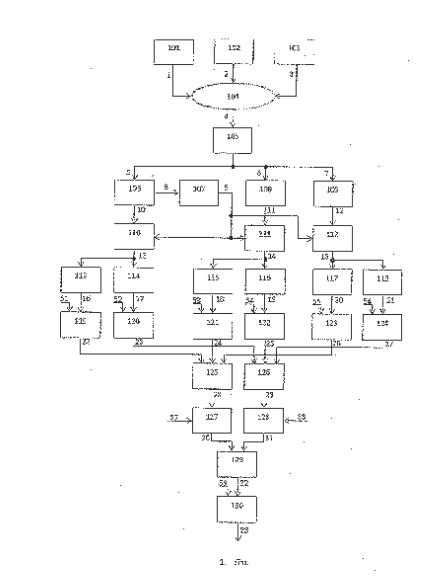
1. Ierīce ādas melanomas atšķiršanai no labdabīgas dzmumzīmes, kas sastāv no gaismas avotiem (101), (102) un (103) ar atšķirīgiem izstarotās gaismas centrālajiem viļņu garumiem λ 1 , λ 2 , λ 3 , kuri secīgi apstaro pētāmoādas objektu (104), un detektora (105), kas uztver no objekta difūzi atstaroto gaismu un pārveido to optiskā blīvuma attēlos, un kas atšķiras ar to, ka:-detektora (105) izeja pieslēgta pie atmiņas bloku (106), (108), (109) attiecīgajām ieejām (5), (6) un (7);
-atmiņas bloku (106), (108), (109) izejas attiecīgi pieslēgtas pie atmiņas bloku (110), (111), (112) datu ieejām;
-atmiņas bloka (106) izeja pieslēgta pie segmentācijas bloka (107) ieejas;
-segmentācijas bloka (107) izeja pieslēgta pie atmiņas bloku (110), (111), (112) vadības ieejām;
- atmiņas bloku (110), (111), (112) izejas (13), (14), (15) pieslēgtas pie vidējās vērtības aprēķina bloku (113), (115), (117)un standartnovirzes aprēķina bloku (114), (116), (118) attiecīgajām ieejām;
- vidējās vērtības aprēķina bloku (113), (115), (117) izejas (16), (18), (20) pieslēgtas attiecīgi pie komparatoru (119), (121), (123 p)irmajām ieejām, bet uz komparatoru (119), (121), (123) otrajām ieejām (51), (53), (55) attiecīgi padotas konstantas sliekšņu vērtības;
- standartnovirzes aprēķina bloku (114), (116), (118) izejas (17), (19), (21) pieslēgtas attiecīgi pie komparatoru (120), (122), (124) pirmajām ieejām, bet uz komparatoru (120), (122), (124) otrajām ieejām (52), (54), (56) attiecīgi padotas konstantas sliekšņu vērtības;
- komparatoru (119), (121), (123) izejas pieslēgtas pie summatora (125) ieejām; - komparatoru (120), (122), (124) izejas pieslēgtas pie summatora (126) ieejām;
- summatora (125) izeja pieslēgta pie reizinātāja (127) pirmās ieejas, bet uz reizinātāja (127) otro ieeju (57) padota konstanta reizinātāja vērtība;
- summatora (126) izeja pieslēgta pie reizinātāja (128) pirmās ieejas, bet uz reizinātāja (128) otro ieeju (58) padota konstanta reizinātāja vērtība;
- reizinātāju (127) un (128) izejas pieslēgtas summatora (129) ieejām; - summatora (129) izeja pieslēgta komparatora (130) pirmajai ieejai, bet uz komparatora (130) Otro ieeju padota konstanta vērtība;
- komparatora (130) izeja ir aparāta izeja.