
Ints Mednieks
Dr. sc. comp.
Vadošais pētnieks
Ints Mednieks uzsāka darbu Elektronikas un datorzinātņu institūtā 1980.gadā kā inženieris. Tehnisko zinātņu kandidāts (1988), Dr.dat. (1992). Vairāk nekā 50 publikāciju autors.
Līdzdarbojies zinātniskās pētniecības projektos, kas saistīti ar pseidostohastiskās diskretizācijas un DASP tehnoloģijas izmantošanu. Pašreizējās zinātniskās aktivitātes saistītas ar tālizpētes datu apstrādi.
Galvenās intereses:
- Randomizēta digitālā signālu apstrāde;
- Neortogonālas transformācijas;
- Digitālās signālu apstrādes DASP tehnoloģija;
- Virtuālie instrumenti • Attēlu apstrāde objektu noteikšanai;
- 3D attēlveidošana;
- Tālizpēte;
- Attēlu klasifikācija;
- Neironu tīklu izmantošana tālizpētē.
Līdzautors 1997. gadā Eiropas IT balvu (European IT Prize) saņēmušajai sistēmai “DASP-lab system”.
Projekti
1 rezultāts
Publikācijas
- 2025
JUNO sensitivity to invisible decay modes of neutrons(atveras jaunā logā)
Ints Mednieks, Ángel Abusleme, Thomas Adam, Kai Adamowicz, Shakeel Ahmad, Rizwan Ahmed, Sebastiano Aiello, Fengpeng An, Qi An, Giuseppe Andronico, Nikolay V. Anfimov and Antonelli
European Physical Journal C, Sēj. 85 (1), Springer Nature
Kopsavilkums
We explore the decay of bound neutrons in the JUNO liquid scintillator detector into invisible particles (e.g., n→3ν or nn→2ν), which do not produce an observable signal. The invisible decay includes two decay modes: n→inv and nn→inv. The invisible decays of s-shell neutrons in 12C will leave a highly excited residual nucleus. Subsequently, some de-excitation modes of the excited residual nuclei can produce a time- and space-correlated triple coincidence signal in the JUNO detector. Based on a full Monte Carlo simulation informed with the latest available data, we estimate all backgrounds, including inverse beta decay events of the reactor antineutrino ν¯e, natural radioactivity, cosmogenic isotopes and neutral current interactions of atmospheric neutrinos. Pulse shape discrimination and multivariate analysis techniques are employed to further suppress backgrounds. With two years of exposure, JUNO is expected to give an order of magnitude improvement compared to the current best limits. After 10 years of data taking, the JUNO expected sensitivities at a 90% confidence level are τ/B(n→inv)>5.0×1031years and τ/B(nn→inv)>1.4×1032years. © 2025 Elsevier B.V., All rights reserved.
- 2025
Prediction of energy resolution in the JUNO experiment(atveras jaunā logā)
Ints Mednieks, Ángel Abusleme, Thomas Adam, Kai Adamowicz, Shakeel Ahmad, Rizwan Ahmed, Sebastiano Aiello, Fengpeng An, Qi An, Giuseppe Andronico, Nikolay V. Anfimov and Antonelli
Chinese Physics C, Sēj. 49 (1), Institute of Physics
Kopsavilkums
This paper presents an energy resolution study of the JUNO experiment, incorporating the latest knowledge acquired during the detector construction phase. The determination of neutrino mass ordering in JUNO requires an exceptional energy resolution better than 3% at 1 MeV. To achieve this ambitious goal, significant efforts have been undertaken in the design and production of the key components of the JUNO detector. Various factors affecting the detection of inverse beta decay signals have an impact on the energy resolution, extending beyond the statistical fluctuations of the detected number of photons, such as the properties of the liquid scintillator, performance of photomultiplier tubes, and the energy reconstruction algorithm. To account for these effects, a full JUNO simulation and reconstruction approach is employed. This enables the modeling of all relevant effects and the evaluation of associated inputs to accurately estimate the energy resolution. The results of this study reveal an energy resolution of 2.95% at 1 MeV. Furthermore, this study assesses the contribution of major effects to the overall energy resolution budget. This analysis serves as a reference for interpreting future measurements of energy resolution during JUNO data collection. Moreover, it provides a guideline for comprehending the energy resolution characteristics of liquid scintillator-based detectors. © 2025 Elsevier B.V., All rights reserved.
- 2023
Classification of satellite images using Dynland technology(atveras jaunā logā)
Martins Pukitis, Ints Mednieks
Ninth International Conference on Remote Sensing and Geoinformation of the Environment (RSCy2023), Sēj. 127860, Proc. SPIE 12786
Kopsavilkums
Satellite images are widely used for land cover classification into predefined categories. To perform it in a practicable way, field data are needed to train and test a classifier. The collection of accurate field data requires significant resources, and image data of a category may have sophisticated distribution in the feature space. “Dynland” technology was developed to overcome these problems and offer a robust and practical way to classify such images. It is based on a nonparametric clustering method applicable to data with different distributions with a following assignment of classes to clusters based on their overlapping with available reference data which can be scarce and imprecise. Dynland clustering algorithm provides meaningful clusters but requires huge computational resources currently limiting the size of processed images. To overcome this problem, we propose to apply a sampling procedure i.e. use each 𝑛-th pixel on both axes for clustering and distribute the remaining pixels to created clusters based on nearest neighbors’ search. However, such an approach reduces the classification accuracy; the analysis results of this reduction will be presented. Another way how to deal with images of large areas is to split them into fragments. To classify a fragment, reference data for all categories of interest should be available for the area it represents. This limitation should be resolved so that the available reference data are used for areas not limited to one fragment. To deal with that, a method is proposed allowing to exploit the classification result of a neighboring fragment for which the reference data were available in full. The proposed solutions widened the applicability of the Dynland technology e.g. enabled the production of a classified map of mires and peatlands for the whole territory of Latvia.
Indeksēts Scopus / WoS
- 2022
Automated delineation of microstands in hemiboreal mixed forests using stereo GeoEye-1 data(atveras jaunā logā)
Linda Gulbe, Juris Zarins, Ints Mednieks
MPDI Open Access Journals, Sēj. 14 (6), lpp. https://www.mdpi.com/2072-4292/14/6/1471, MDPI
Kopsavilkums
A microstand is a small forest area with a homogeneous tree species, height, and density composition. High-spatial-resolution GeoEye-1 multispectral (MS) images and GeoEye-1-based canopy height models (CHMs) allow delineating microstands automatically. This paper studied the potential benefits of two microstand segmentation workflows: (1) our modification of JSEG and (2) generic region merging (GRM) of the Orfeo Toolbox, both intended for the microstand border refinement and automated stand volume estimation in hemiboreal forests. Our modification of JSEG uses a CHM as the primary data source for segmentation by refining the results using MS data. Meanwhile, the CHM and multispectral data fusion were achieved as multiband segmentation for the GRM workflow. The accuracy was evaluated using several sets of metrics (unsupervised, supervised direct assessment, and system-level assessment). Metrics were calculated for a regular segment grid to check the benefits compared with the simple image patches. The metrics showed very similar results for both workflows. The most successful combinations in the workflow parameters retrieved over 75 % of the boundaries selected by a human interpreter. However, the impact of data fusion and parameter combinations on stand volume estimation accuracy was minimal, causing variations of the RMSE within approximately 7 m3/ha.
Scopus procentile: 91 · SNIP: 1.546
- 2021
The design and sensitivity of JUNO’s scintillator radiopurity pre-detector OSIRIS(atveras jaunā logā)
Angel Abusleme, Joao Pedro Athayde Marcondes de Andre, Andrej Babic, Anatael Cabrera, Timo Enqvist, Andrea Fabbri, Haonan Gan, Paul Hackspacher, Ara Ioannisian, Beatrice Jelmini, Leonidas Kalousis, Tobias Lachenmaier, Bangzheng Ma, Massimiliano Nastasi, Lothar Oberauer, Hsiao-Ru Pan, Luis Felipe Pineres Rico, Fazhi Qi, Andrey Sadovsky, Jian Tang, Nikita Ushakov, Johannes van den Boom, Pablo Walker, Yufei Xi, Baojun Yan, Noman Zafar, Ints Mednieks, J. Miller, P. Montini, A. Müller
European Physical Journal C, Sēj. 81 (11), lpp. 973, Springer Science and Business Media Deutschland GmbH
Kopsavilkums
The OSIRIS detector is a subsystem of the liquid scintillator filling chain of the JUNO reactor neutrino experiment. Its purpose is to validate the radiopurity of the scintillator to assure that all components of the JUNO scintillator system work to specifications and only neutrino-grade scintillator is filled into the JUNO Central Detector. The aspired sensitivity level of 10-16g/g of 238U and 232Th requires a large (∼20m3) detection volume and ultralow background levels. The present paper reports on the design and major components of the OSIRIS detector, the detector simulation as well as the measuring strategies foreseen and the sensitivity levels to U/Th that can be reached in this setup. © 2021, The Author(s)
Indeksēts Scopus / WoS · Q1/Q2 žurnāls · SNIP: 1.339
Patenti
2015 LR patents Nr.14998
Ierīce ādas melanomas atšķiršanai no labdabīgas dzimumzīmes
Izgudrotāji:Aivars Lorencs, Ints Mednieks, Juris Siņica-Siņavskis, Dainis Jakovels, Dmitrijs Bļizņuks
Apraksts un saite
Skatīt patentu Espacenet datubāzē(atveras jaunā logā)LR patents Nr.14998. "Ierīce ādas melanomas atšķiršanai no labdabīgas dzimumzīmes". Izgudrotāji: Aivars Lorencs, Ints Mednieks, Juris Siņica-Siņavskis, Dainis Jakovels, Dmitrijs Bļizņuks. Īpašnieks Elektronikas un datorzinārņu institūts, Latvijas Universitātes Atomfizikas un spektroskopijas institūts. Publicēts 20.08.2015.
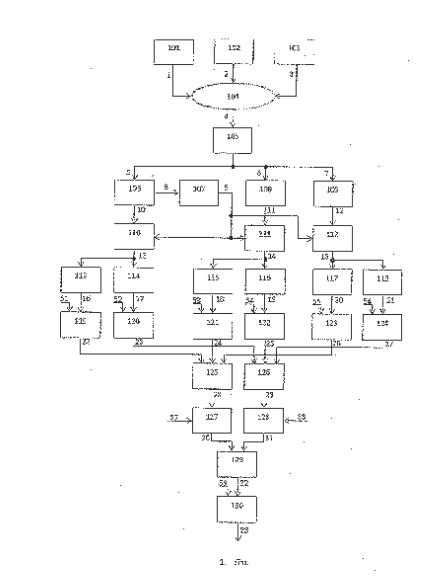
1. Ierīce ādas melanomas atšķiršanai no labdabīgas dzmumzīmes, kas sastāv no gaismas avotiem (101), (102) un (103) ar atšķirīgiem izstarotās gaismas centrālajiem viļņu garumiem λ 1 , λ 2 , λ 3 , kuri secīgi apstaro pētāmoādas objektu (104), un detektora (105), kas uztver no objekta difūzi atstaroto gaismu un pārveido to optiskā blīvuma attēlos, un kas atšķiras ar to, ka:-detektora (105) izeja pieslēgta pie atmiņas bloku (106), (108), (109) attiecīgajām ieejām (5), (6) un (7);
-atmiņas bloku (106), (108), (109) izejas attiecīgi pieslēgtas pie atmiņas bloku (110), (111), (112) datu ieejām;
-atmiņas bloka (106) izeja pieslēgta pie segmentācijas bloka (107) ieejas;
-segmentācijas bloka (107) izeja pieslēgta pie atmiņas bloku (110), (111), (112) vadības ieejām;
- atmiņas bloku (110), (111), (112) izejas (13), (14), (15) pieslēgtas pie vidējās vērtības aprēķina bloku (113), (115), (117)un standartnovirzes aprēķina bloku (114), (116), (118) attiecīgajām ieejām;
- vidējās vērtības aprēķina bloku (113), (115), (117) izejas (16), (18), (20) pieslēgtas attiecīgi pie komparatoru (119), (121), (123 p)irmajām ieejām, bet uz komparatoru (119), (121), (123) otrajām ieejām (51), (53), (55) attiecīgi padotas konstantas sliekšņu vērtības;
- standartnovirzes aprēķina bloku (114), (116), (118) izejas (17), (19), (21) pieslēgtas attiecīgi pie komparatoru (120), (122), (124) pirmajām ieejām, bet uz komparatoru (120), (122), (124) otrajām ieejām (52), (54), (56) attiecīgi padotas konstantas sliekšņu vērtības;
- komparatoru (119), (121), (123) izejas pieslēgtas pie summatora (125) ieejām; - komparatoru (120), (122), (124) izejas pieslēgtas pie summatora (126) ieejām;
- summatora (125) izeja pieslēgta pie reizinātāja (127) pirmās ieejas, bet uz reizinātāja (127) otro ieeju (57) padota konstanta reizinātāja vērtība;
- summatora (126) izeja pieslēgta pie reizinātāja (128) pirmās ieejas, bet uz reizinātāja (128) otro ieeju (58) padota konstanta reizinātāja vērtība;
- reizinātāju (127) un (128) izejas pieslēgtas summatora (129) ieejām; - summatora (129) izeja pieslēgta komparatora (130) pirmajai ieejai, bet uz komparatora (130) Otro ieeju padota konstanta vērtība;
- komparatora (130) izeja ir aparāta izeja.
2009 LR patents Nr. 13942
Digitālu pelēko toņu attēlu analizators
Izgudrotāji:I.Mednieks, A.Skaģeris
Apraksts un saite
Skatīt patentu Espacenet datubāzē(atveras jaunā logā)LR patents Nr. 13942 “Digitālu pelēko toņu attēlu analizators”. Izgudrotāji: I.Mednieks, A.Skaģeris. Īpašnieks: Elektronikas un datorzinātņu institūts. Publicēts 20.08.2009.
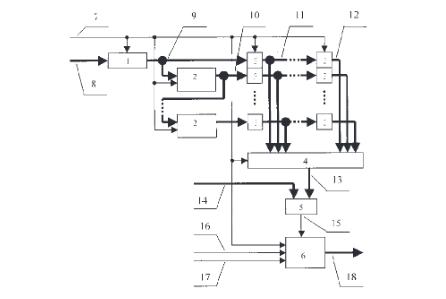
Digitālu pelēko toņu attēlu analizators, kas ieejās saņem attēla katra pikseļa gaišumam atbilstošu paralēlo kodu, pikseļu un rindu taktsignālus un satur filtru mainīgā fona izslēgšanai, kas atšķiras ar to, ka ir paredzēts vienlaicīgai attēla r rindu nepārtrauktai analīzei pa r x r pikseļu izmēra attēla fragmentiem un satur: r-1 virknē slēgtas FIFO tipa operatīvās atmiņas, kuru garums sakrīt ar pikseļu skaitu attēla rindā; r x r pikseļu paralēlā koda reģistrus; aritmētisko operāciju moduli, kas nepieciešams attēla fragmentu pikseļu kovariāciju raksturojošā koeficienta aprēķināšanai katram analizējamajam attēla fragmentam; koda komparatoru aprēķinātā koeficienta salīdzināšanai ar uz prakses pamata izvēlētu līmeni, lai attēlā atklātu par fonu tumšākus apgabalus, kas norāda uz svešķermeņu klātbūtni kontrolējamajā objektā; trauksmes signālierīci, kas bloķē iespējamos neīstos trauksmes signālus, kas var rasties analizējot ikvienas attēla rindu grupas pēdējos r-1 pikseļus, kad kopā ar šiem pikseļiem analizēti tiek nākamās jaunās attēla rindu grupas pirmie pikseļi, kas ģeometriski atrodas attēla pretējā pusē.
http://www.lrpv.gov.lv/sites/default/files/media/vestnesis/20090820.pdf
2009 LR patents Nr. 13857
Digitālu rentgena attēlu analizators svešķermeņu atklāšanai objektos reālā laika režīmā
Izgudrotāji:I.Mednieks, A.Skaģeris
Apraksts un saite
Skatīt patentu Espacenet datubāzē(atveras jaunā logā)LR patents Nr. 13857 “Digitālu rentgena attēlu analizators svešķermeņu atklāšanai objektos reālā laika režīmā”. Izgudrotāji: I.Mednieks, A.Skaģeris. Īpašnieks: Elektronikas un datorzinātņu institūts. Publicēts 20.03.2009.
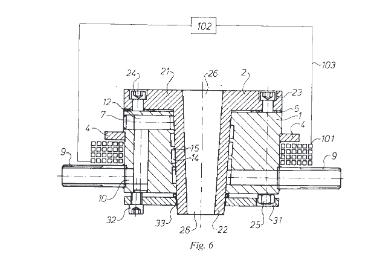
1. Bronzas nepārtrauktās liešanas elektromagnētiskais kristalizators, kas atšķirīgs ar to, ka korpusa (1) centrālajā atverē caur tā izeju (22) ir ievietots konusveida ieliktnis (2), starp ieliktņa (2) cilindrisko izeju (21) un korpusa (1) augšējo virsmu ir ievietots korķis (5), korpuss (1) un ieliktnis (2) ir savienoti ar skrūvēm (24) un uzgriežņiem (25), pie kam uz korpusa (1) apakšējās daļas caur "O" veida gredzenu (6) ir uzstādīts vāciņš (3) un piestiprināts ar skrūvēm (32), korpusa (1) ejā (41) ir ievietots gredzens (4) un piestiprināts korpusam (1), turklāt caurumos (8) ir uzstādīti savienojumi (9) un piemetināti korpusam (1).
2. Bronzas nepārtrauktās liešanas elektromagnētiskais kristalizators saskaņā ar 1.punktu, kas atšķirīgs ar to, ka starp savienojumiem (9) un gredzenu (4) ir izvietoti daudzi induktora (101) vijumi, kuri caur vadītājiem (103) ir savienoti ar invertoru (102).
3. Bronzas nepārtrauktās liešanas elektromagnētiskais kristalizators saskaņā ar 1.punktu, kas atšķirīgs ar to, ka šķērsprofilu diametri D2 un D1 atrodas aptuvenā attiecībā D2:D1 = 1:(3,9 līdz 1,77), šķērsprofilu diametri D4 un D3 atrodas aptuvenā attiecībā D4:D3 = 1:(1,684 līdz 1,262), bet garumi L2 un L1 garums atrodas aptuvenā attiecībā L2:L1 = 1:(1,208 līdz 1,16).
4. Bronzas nepārtrauktās liešanas elektromagnētiskais kristalizators saskaņā ar 1.punktu, kas atšķirīgs ar to, ka korpusa (1) centrālajā atverē ir izveidotas spirālveidā izkārtotas ribas (15), kuras savā starpā veido spirālveida kanālus (14), un ar to, ka korpusā (1) izveidoti caurumi (8, 10, 11, 12, 13), pie kam caurumi (11, 12) ir noslēgti ar necaurejošu korķi (7), kas piemetināts korpusam (1).
5. Bronzas nepārtrauktās liešanas elektromagnētiskais kristalizators saskaņā ar 1. punktu, kas atšķirīgs ar to, ka konusveida ieliktnī (2) ir izveidota centrālā konusveida atvere (26), bet cilindriskajā izejā (21) ir izveidotas daudzas atveres (23).
6. Bronzas nepārtrauktās liešanas elektromagnētiskais kristalizators saskaņā ar 1.punktu, kas atšķirīgs ar to, ka apakšējā vāciņā (3) ir izveidota centrālā atvere (33), kā arī liels skaits apļveida atveru (31) un liels skaits apļveida atveru (34).