5 November 2026
International defence technology validation centre AlliedTechLabs established at the Institute of Electronics and Computer Science
30 October 2026
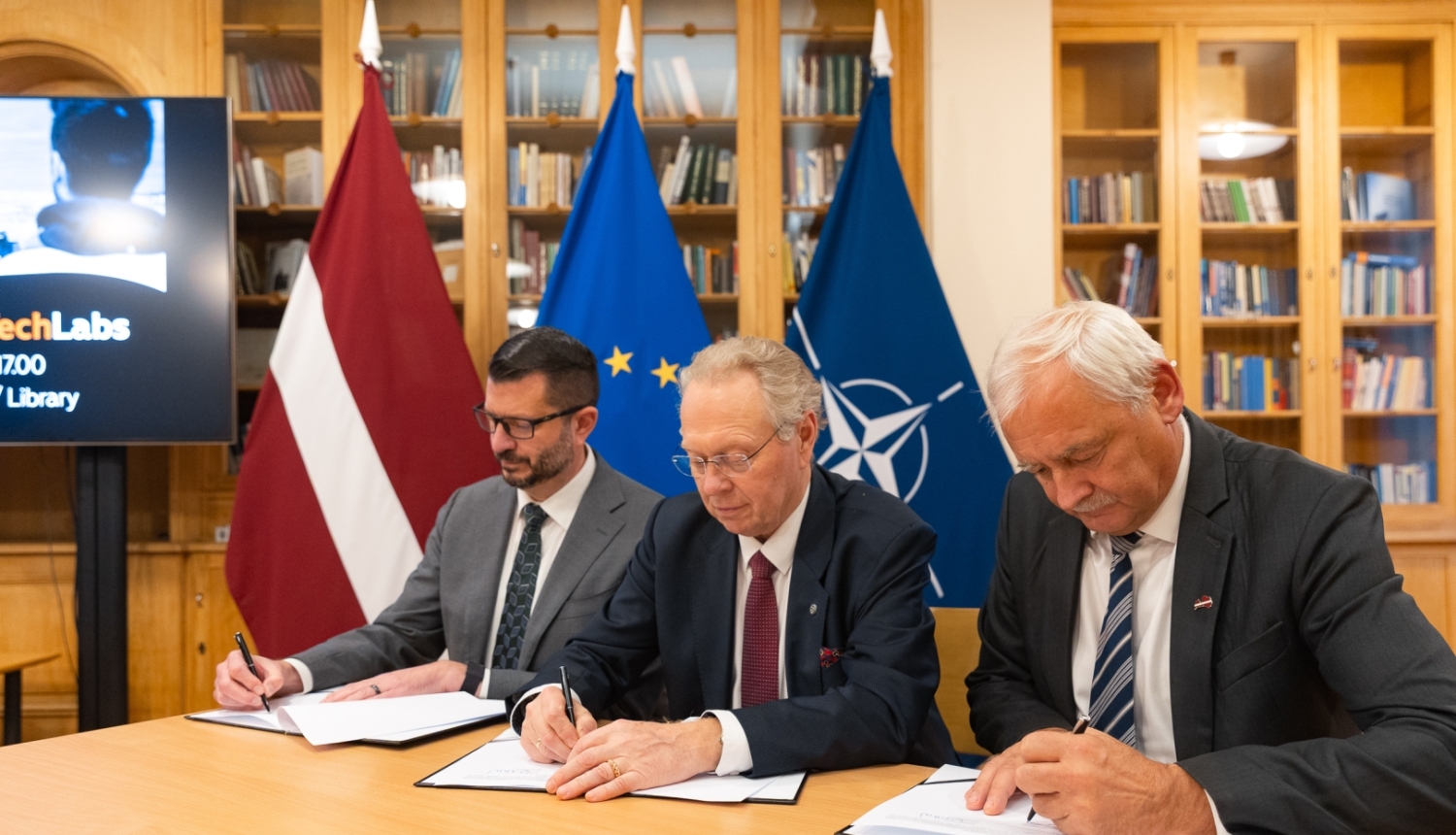
On 30 October, at the Cabinet of Ministers of Latvia, Finnish defence technology company NestAI, the Institute of Electronics and Computer Science (IECS) and LMT Group signed a memorandum of understanding to establish AlliedTechLabs (ATL), an international research centre for defence and dual-use technologies. The initiative brings together the public, industrial and academic sectors to create an international validation centre in Latvia for civil and military communication technologies.
The new centre will operate as a specialised unit within IECS. It is supported by LMT Group, the Ministry of Defence, the Ministry of Education and Science and Riga City Council.
“In Latvia, we must be able not only to acquire technologies developed elsewhere, but to develop, test, and turn our own innovations into competitive products. AlliedTechLabs is an important step in that direction, creating an international environment in Latvia where the expertise of our companies and researchers connects with the knowledge, experience, and needs of our Allies. It gives us an opportunity to jointly develop and test new defence and dual-use solutions in real-world conditions. The benefits are clear: stronger defence capabilities for Latvia and our Allies, new opportunities for Latvian technology companies, and high-value products that can compete in global markets,” underlines Prime Minister Andris Kulbergs.
ATL will provide NATO, allied operators and industry with a realistic test environment for evaluating integrated systems. Its main focus will be applied research and technology development, taking solutions from laboratory testing to field-ready technologies validated in realistic conditions.
The centre’s key areas of activity will be:
next-generation communication networks (5G/6G) and integrated communications;
environmental sensing and signal processing;
artificial intelligence;
edge computing, that is, processing data as close as possible to where it is collected (on the device, sensor, vehicle or a local server) without sending it to a data centre or cloud service.
ATL will combine telecommunications infrastructure, 5G testing capabilities for military needs, an urban test environment and IECS’s in-depth scientific expertise in a single ecosystem, offering international and regional partners a neutral environment for testing and validating technologies in realistic conditions. The centre will connect Latvian technology developers with the Allied Tech Stack and with EU, NATO and US 6G initiatives. It will also give governments independent, evidence-based expertise on technology standards and investment priorities. ATL will also work with Ukrainian partners to translate experience from real-world combat and civil resilience into concrete testing standards and proposals for NATO and the EU.
NestAI joins the centre as a strategic industry partner and aims to bring NestOS, its adaptive operating system for modern battlefield operations, into ATL’s demonstrations and testing. The MoU sets out steps toward NestAI’s intended contribution of up to €1 million over three years.
“European defence AI will only be competitive if it is built to work across allies. AlliedTechLabs is designed to test allied technology on shared ground, and NestOS is built as an open, modular platform for exactly that. Through AlliedTechLabs, NestAI aims to strengthen the capabilities of allied forces across NATO’s Eastern Flank, connecting our R&D centre in Latvia to the forces it is built for,” says Peter Sarlin, Founder & Executive Chairman of NestAI.
“AlliedTechLabs creates a unique platform in Latvia where companies from across the Alliance can develop, test and validate technologies for real-world defence needs. NestAI’s participation as a strategic industry partner brings defence AI expertise into the initiative from the very beginning, while LMT Group will provide its network infrastructure and engineering capabilities. Together, we are creating an environment where innovators and Allied forces can accelerate next-generation technologies from development towards operational use,” says Juris Binde, President of LMT Group.
The signing was attended by government, NATO and industry representatives from Latvia, Canada, Finland, France, Germany, Norway, Sweden and the United States.