Energy
Essence and Objective of the Research Area
The research area focuses on the sustainable development of the energy system. This underpins the growth of the Latvian economy and the well-being of its population, and also contributes to climate change mitigation and the improvement of environmental quality.
The challenges of developing modern energy systems sustainably extend far beyond the boundaries of engineering: their development must take account of economic, environmental and climate, and social aspects (including the participation of end consumers). The challenge lies in integrating all of these aspects harmoniously into a single system. Smart energy research has therefore become a highly interdisciplinary and multidisciplinary field that brings together a range of scientific disciplines.
The research area provides evidence-based information, expertise and support to decision-makers in the public and industrial sectors. We offer analytical assessments of alternative pathways for decarbonising the Latvian energy system and address the challenges of public engagement in the energy transition. Working with industrial partners, we demonstrate and test these solutions in practice.
Historical and Scientific Background
The research area was established at EDI in 2025, when the Institute of Physical Energetics was integrated into EDI. The research team involved has diverse, long-standing and complementary experience in fields essential to smart energy research: energy and environmental engineering, electrical engineering, electronics and information technology (IT), economics, and environmental and climate governance. The research relies on high-performance analysis and modelling tools, making extensive use of the opportunities offered by IT and mathematical modelling.
The energy research area combines fundamental and applied science. The development of methodologies and modelling tools, numerical modelling and data analytics methods form its scientific foundation, while the results are used directly in the development of national strategies and policies, in measurement campaigns and in industrial demonstration projects.
Our research is characterised by the following keywords:
- sustainable energy systems, renewable energy sources, energy efficiency;
- smart energy grids, grid flexibility and security, distributed generation, end-consumer engagement, energy communities;
- systems analysis, modelling;
- energy system decarbonisation;
- information and communication technologies, artificial intelligence.
Key Achievements, Innovations and Applications
The institute’s researchers have long participated in the ODYSSEE-MURE project. ODYSSEE-MURE is a long-running initiative, supported and co-funded by the European Commission since 1993, to assess energy efficiency trends and policies across Europe. It provides data, indicators and analytical tools that help policymakers in the European Commission and EU Member States to design measures for achieving energy efficiency targets and to measure their contribution to those targets.
The TIMES-Latvia model developed by the team is actively used to model scenarios for decarbonising the energy sector and for the transition of the economy towards climate neutrality. Its results have provided the analytical basis for a number of Latvian strategic documents in the field of energy and climate policy, including the NECP 2030
Competences, Future Directions and Development
EDI’s energy research competence covers three interrelated research sub-areas that contribute to the modernisation and development of the energy sector.
The first sub-area: comprehensive analysis of sustainable energy system development and integrated modelling tools.
Research in the first sub-area focuses on developing and assessing alternatives for decarbonising the Latvian energy system and achieving climate neutrality by the middle of the century. The research takes an interdisciplinary approach, assessing the contribution required from all sectors of the economy and the interactions between them, while taking into account the overall requirements and targets of environmental and climate policy for limiting air pollutant and greenhouse gas (GHG) emissions. Specifically, in the energy sector we develop and model medium- and long-term development scenarios for the energy–environment system and carry out an integrated analysis of the results. This analysis incorporates rapidly evolving new energy generation and consumption technologies and takes into account the challenges of ensuring security of energy supply. The research analyses solutions for expanding the use of renewable energy sources, including in the transport sector, and for the broad integration of energy efficiency measures to support the sustainable development of the energy system. It also models long-term projections of GHG and air pollutant emissions and assesses the economic and social impacts of implementing energy and climate policy.
Laboratories, equipment and data resources
The main modelling and analysis tool is the TIMES modelling platform, on which we have built the specific TIMES-Latvia model. We also develop and use other decision-support tools, such as a mathematical model for assessing climate change mitigation measures and analysing their impact at regional level, the COPERT 5 model for calculating road transport emissions, and others.
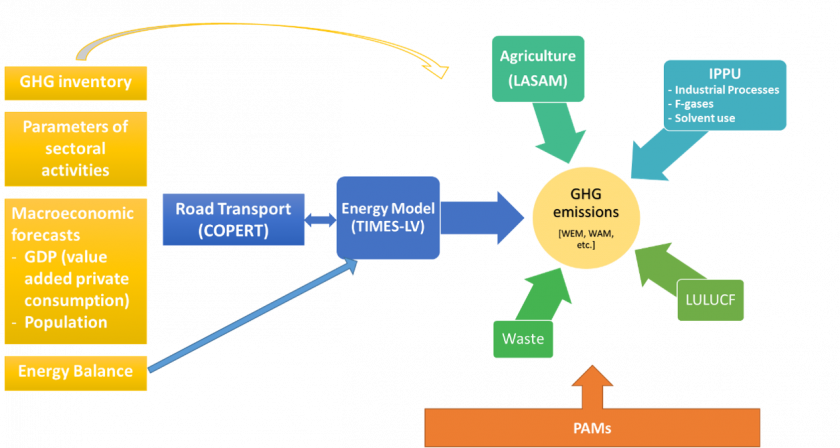
Energy–environment modelling framework
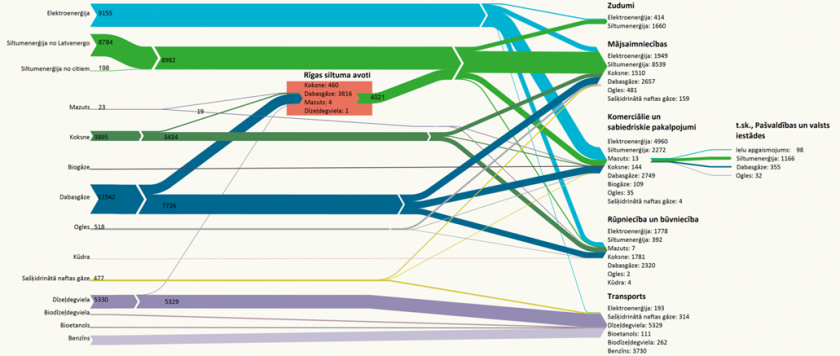
Example of scenario modelling results
The integration of the model’s long-term and short-term scales is currently being improved. As the share of wind and solar energy in electricity generation increases, short-term flexibility checks are needed, and the model’s temporal resolution is therefore being increased.
In the near future, we plan to include aspects of the hydrogen economy in the model in greater detail, including detailed modelling of the infrastructure layout for green hydrogen production, storage and cross-border pipelines.
An equally important issue is the inclusion of a climate feedback mechanism in the model, i.e. taking into account the impact of climate change on the energy system itself (for example, how higher summer air temperatures change cooling demand or reduce the availability of hydropower).
Research team of the sub-area: 5 staff members (including 5 holders of a doctorate in engineering sciences).
The second sub-area: innovative solutions for the development and monitoring of smart energy.
We develop solutions that improve the efficiency of electricity generation, distribution, transmission and consumption, enhance the flexibility and security of electricity grids, and promote distributed generation and the active engagement of end consumers. The results provide the scientific, technical and economic basis for smart grid infrastructure, built on the integration of renewable energy sources, electricity storage systems, demand response mechanisms and improved grid management. ICT and artificial intelligence are applied to load forecasting, grid stability improvement and energy management algorithms. The sub-area also carries out power quality monitoring in the distribution network and develops solutions for detecting faults and transients from frequency measurements.
Research in the sub-area relies on an interconnected hardware and software infrastructure. This includes:
- power system modelling tools (DIgSILENT PowerFactory, HYPERSIM and ePHASORSIM);
- a real-time simulation set-up (an OPAL-RT OP4610XG real-time simulator and 4 WAMSTER STERPMU-R1 phasor measurement units);
- a monitoring system (a National Instruments FPGA-based phasor measurement unit together with an SEL-5073 phasor data concentrator and a fault detection system);
- other research infrastructure elements.
Research team of the sub-area: 7 staff members (including 2 holders of a doctorate in engineering sciences and 2 doctoral students).
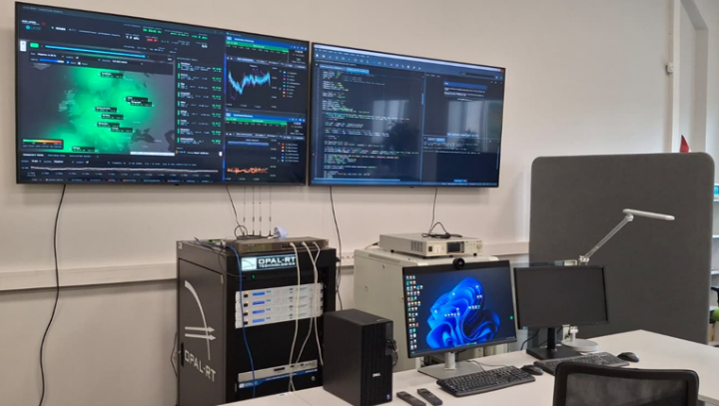
Smart energy research and monitoring infrastructure
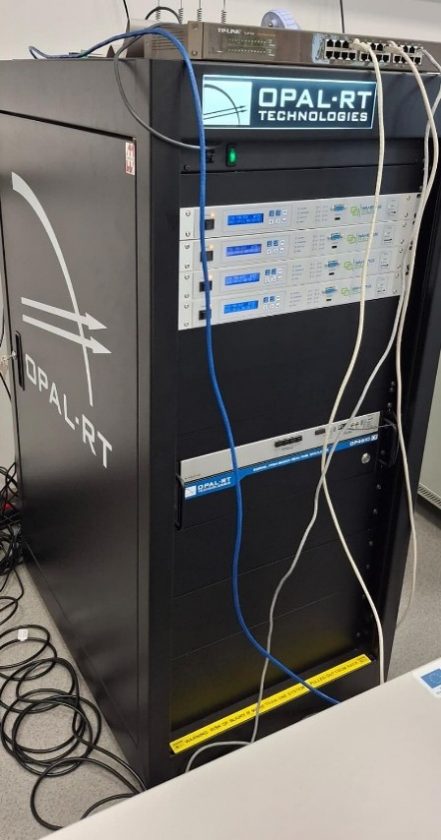
Real-time simulator set-up
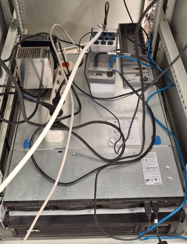
National Instruments FPGA-based phasor measurement unit
The third sub-area: research on the rational and efficient use of renewable energy resources.
The research covers a broad range of energy topics, including wind resource assessment and forecasting, magnetic field modelling and optimisation strategies for electrical machines.
Research and assessment of wind energy potential rely on long-term measurements using meteorological masts and remote sensing devices. These provide high-precision measurements of wind speed and direction at different heights, delivering reliable and verifiable wind resource data across a range of climatic and topographic conditions, which is essential for the planning and development of energy systems. Future research will focus on applying machine learning algorithms and data analytics to improve the accuracy of wind resource assessment and wind speed forecasting, and to optimise the layout of wind turbines within wind farms.
Research on magnetic field modelling and electrical machine optimisation focuses on analysing electromagnetic processes, studying magnetic flux distribution and developing efficient design solutions. This work uses numerical modelling methods, including the finite element method, to analyse magnetic field distribution and to assess electromagnetic forces, losses and equipment efficiency. The research also covers geometry optimisation strategies for electrical machines to improve their performance and adapt solutions to a range of energy applications.
Laboratories, equipment and data resources: WindCube LiDAR with vertical profile measurements.
Research team of the sub-area: 7 staff members (including 2 holders of a doctorate in engineering sciences).
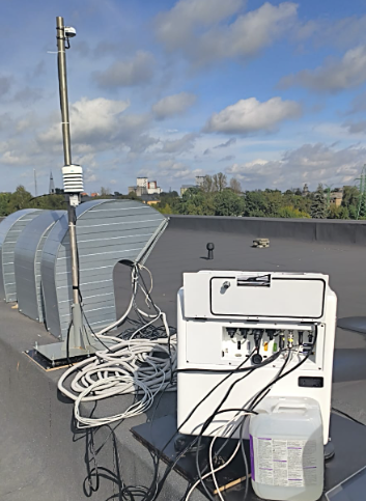
WindCube LiDAR system installed on the EDI premises
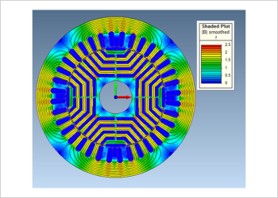
Modelling of electromagnetic field distribution in an electrical machine