Contact
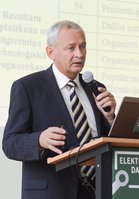
Modris Greitāns
Dr. sc. comp.
Director of EDI, Senior Researcher
Dr. sc. comp., Member of the Latvian Academy of Sciences Modris Greitāns has been working at the Institute of Electronics and Computer Science (EDI) since 1990. He has been the director of the institute since 2007 (from 2015 to 2019 – scientific director). He obtained his Doctor degree in 2000, defending his PhD thesis "Reconstruction of non-uniformly sampled signals". In 2012, he was elected as corresponding member of the Latvian Academy of Sciences, and in 2018, as a full member. His scientific research topics include signal and image processing, artificial intelligence, Internet of Things applications in smart transport, future and personalized medicine (smart wearable sensor systems), Industry 4.0 solutions, as well as security, etc.
From 2014 to 2017, he led the National Research Program in the field of ICT, "Cyber-physical systems, ontologies and biophotonics for a safe & Intelligent city and society" (SOPHIS), in which a significant section is devoted to the development of smart embedded cooperative system technologies. Since 1992, he has gained experience in the management and implementation of more than 20 international and 20 Latvian research projects. Currently, he is the head of the Latvian partner's part in the Horizon Europe projects SUSTRONICS (dedicated to the development of sustainable electronic components) and EdgeAI (dedicated to peripheral artificial intelligence in mobility applications).
The total number of published scientific works exceeds 150, including 111 publications in the SCOPUS database (H-index 15). He is the co-author of three registered European patents and seven Latvian patents. He has supervised seven successfully defended PhD's and more than thirty master's theses.
In 2018, he received the Eižens Āriņš Award (“Eižena Ārina balva”), the highest award in the IT industry in Latvia. He was co-author of the DASP-lab system, which received the European IT Prize in 1997. He is the lead co-author of several works that have received letters of appreciation from the President of the Latvian Academy of Sciences – "First self-driving car trips in Latvia" (2017) and "An original approach to transforming artificial neural network architecture into programmable logical array structures" (2018). Co-author of works that received the Latvian Science Achievement Award in 2022 – "A unique industrial robotics solution has been created – a smart robot with advanced vision, sensing, and human gesture understanding capabilities" and in 2024 – "Robot cognitive perception and high-level instruction interpretation with natural language concepts.
He is the editor-in-chief of the journal "Automatic Control and Computer Science", foreign affairs secretary and board member of the Latvian Academy of Sciences, board member of the Association of State Scientific Institutes, member of the EDI Scientific Council, and member of the promotion councils of RTU and LU.
Projects
4 results
- Contract research about image processing algorithm creation for recognizing of symbols combination in video stream (KoDe)
- Cyber-physical systems, ontologies and biophotonics for safe&smart city and society (VPP SOPHIS)
- Project Nr.2 "Innovative signal processing technologies for smart and effective electronic system development" (IMIS)
- 1.25: Research on development of mathematical model for silicon crystal growing technological process by using image processing methods (SiKA)
Publications
- 2025
Implementation of LoRa TDMA-Based Mobile Cell Broadcast Protocol for Vehicular Networks(opens in a new window)
Modris Greitāns, Gatis Gaigals, Aleksandrs Ļevinskis
Information (Switzerland), Vol. 16 (6), MDPI
- 2025
Correction to: Towards Open-Set NLP-Based Multi-Level Planning for Robotic Tasks(opens in a new window)
Peteris Racinskis, Oskars Vismanis, Toms Eduards Zinars, Janis Arents, Modris Greitans
Applied Sciences (Switzerland), Vol. 15 (5), MDPI
- 2025
Model Selection and Prompting Strategies in Resource Constrained Environments for LLM-based Robotic System(opens in a new window)
Toms Eduards Zinars, Oskars Vismanis, Peteris Racinskis, Janis Arents, Modris Greitans
Charting the Intelligence Frontiers Edge AI Systems Nexu, p. 147-165, River Publishers Series in Communications and Networking
- 2025
The EDI Multi-Modal Simultaneous Localization and Mapping Dataset (EDI-SLAM)(opens in a new window)
Peteris Racinskis , Gustavs Krasnikovs, Janis Arents and Modris Greitans
Data, Vol. 10 (1), p. 5, MDPI
- 2025
Multi-Step Object Re-Identification on Edge Devices: A Pipeline for Vehicle Re-Identification
Tomass Zutis, Peteris Racinskis, Anzelika Bureka, Janis Judvaitis, Janis Arents, and Modris Greitans
Charting the Intelligence Frontiers – Edge AI Systems Nexus, p. 233-253, River Publishers
Patents
- 2018
LR patents Nr. 15308
LR patents Nr. 15308 “Mobila ierīce bezvadu sensoru tīklu un to mezglu efektīvai izstrādei mērķa vide”, Izgudrotāji Leo SEĻĀVO, Krišjānis NESENBERGS, Jānis JUDVAITIS, Didzis LAPSA, Rihards BALAŠS, Arnis SALMIŅŠ, Modris GREITĀNS, publicēts 20.03.2018.
- 2016
European Patent No. EP 2695104 B1
EP2695104 (type: A1, date: 12.02.2014; type: B1, date: 27.07.2016) “Biometric authentication apparatus and biometric authentication method”. Inventors: M.Greitans, M.Pudzs, R.Fuksis, R.Ruskuls. Applicant:
Institute of Electronics and Computer Sciences of Latvia. - 2015
European Patent No. EP2700054 B1
EP2700054 (type: A1, date: 26.02.2014; type: B1, date: 22.04.2015) “System and method for video-based vehicle detection”. Inventors: K.Freivalds, R.Kadikis, M.Greitans. Applicant:
Institute of Electronics and Computer Sciences of Latvia. - 2015
European Patent No. EP2695297 B1
EP2695297 (type: A1, date: 12.02.2014; type: B1, date: 08.07.2015) “Ultra-wideband sharpener for excitation a symmeric antenna”. Inventors: M.Greitans, K.Krumins, V.Aristovs.
Applicant: Institute of Electronics and Computer Sciences of Latvia. - 2013
LR patents Nr. 14767
Latvian Patent No. 14767 “Former of excitation pulses for symmetrical Ultra-wideband (UWB) antenna”. Inventors: M.Greitāns, V.Aristovs, G.Šūpols. Owner: Institute of Electronics and Computer Science. Published: 20.11.2013.
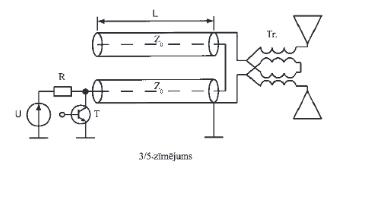
The purpose of the invention is, by modifying circuit of prototype, to obtain a sub-nanosecond impulse former for excitation of a symmetrical ultra-wideband (UWB) antenna. The pulse former consists of two coaxial cable segments with length L and characteristic impedance Z 0 , direct current voltage supply U, charging current limiting resistor R, switch element – avalanche transistor T, symmetrical antenna and asymmetrical pulse former balancing transformer Tr.