Ints Mednieks
Dr. sc. comp.
Senior Researcher
Ints Mednieks is with IECS starting from 1980 as an engineer. Dr.sc.ing. (1988), Dr..sc.comp. (1992). Author of more than 50 publications.
He has been mainly involved in R&D projects related to pseudorandomized DSP and DASP technology. His current research activities are concentrated on remote sensing data processing.
Main interests:
- Randomized Digital Signal Processing;
- Non-orthogonal transforms • Digital Alias-free Signal Processing (DASP) technology;
- Virtual instrumentation;
- Image processing for object detection;
- 3D imaging;
- Remote sensing;
- Image classification.
Neural networks in remote sensing Co-author of the “DASP-lab system” which received the European IT Prize in 1997.
Projects
1 result
Publications
- 2025
JUNO sensitivity to invisible decay modes of neutrons(opens in a new window)
Ints Mednieks, Ángel Abusleme, Thomas Adam, Kai Adamowicz, Shakeel Ahmad, Rizwan Ahmed, Sebastiano Aiello, Fengpeng An, Qi An, Giuseppe Andronico, Nikolay V. Anfimov and Antonelli
European Physical Journal C, Vol. 85 (1), Springer Nature
Abstract
We explore the decay of bound neutrons in the JUNO liquid scintillator detector into invisible particles (e.g., n→3ν or nn→2ν), which do not produce an observable signal. The invisible decay includes two decay modes: n→inv and nn→inv. The invisible decays of s-shell neutrons in 12C will leave a highly excited residual nucleus. Subsequently, some de-excitation modes of the excited residual nuclei can produce a time- and space-correlated triple coincidence signal in the JUNO detector. Based on a full Monte Carlo simulation informed with the latest available data, we estimate all backgrounds, including inverse beta decay events of the reactor antineutrino ν¯e, natural radioactivity, cosmogenic isotopes and neutral current interactions of atmospheric neutrinos. Pulse shape discrimination and multivariate analysis techniques are employed to further suppress backgrounds. With two years of exposure, JUNO is expected to give an order of magnitude improvement compared to the current best limits. After 10 years of data taking, the JUNO expected sensitivities at a 90% confidence level are τ/B(n→inv)>5.0×1031years and τ/B(nn→inv)>1.4×1032years. © 2025 Elsevier B.V., All rights reserved.
- 2025
Prediction of energy resolution in the JUNO experiment(opens in a new window)
Ints Mednieks, Ángel Abusleme, Thomas Adam, Kai Adamowicz, Shakeel Ahmad, Rizwan Ahmed, Sebastiano Aiello, Fengpeng An, Qi An, Giuseppe Andronico, Nikolay V. Anfimov and Antonelli
Chinese Physics C, Vol. 49 (1), Institute of Physics
Abstract
This paper presents an energy resolution study of the JUNO experiment, incorporating the latest knowledge acquired during the detector construction phase. The determination of neutrino mass ordering in JUNO requires an exceptional energy resolution better than 3% at 1 MeV. To achieve this ambitious goal, significant efforts have been undertaken in the design and production of the key components of the JUNO detector. Various factors affecting the detection of inverse beta decay signals have an impact on the energy resolution, extending beyond the statistical fluctuations of the detected number of photons, such as the properties of the liquid scintillator, performance of photomultiplier tubes, and the energy reconstruction algorithm. To account for these effects, a full JUNO simulation and reconstruction approach is employed. This enables the modeling of all relevant effects and the evaluation of associated inputs to accurately estimate the energy resolution. The results of this study reveal an energy resolution of 2.95% at 1 MeV. Furthermore, this study assesses the contribution of major effects to the overall energy resolution budget. This analysis serves as a reference for interpreting future measurements of energy resolution during JUNO data collection. Moreover, it provides a guideline for comprehending the energy resolution characteristics of liquid scintillator-based detectors. © 2025 Elsevier B.V., All rights reserved.
- 2023
Classification of satellite images using Dynland technology(opens in a new window)
Martins Pukitis, Ints Mednieks
Ninth International Conference on Remote Sensing and Geoinformation of the Environment (RSCy2023), Vol. 127860, Proc. SPIE 12786
Abstract
Satellite images are widely used for land cover classification into predefined categories. To perform it in a practicable way, field data are needed to train and test a classifier. The collection of accurate field data requires significant resources, and image data of a category may have sophisticated distribution in the feature space. “Dynland” technology was developed to overcome these problems and offer a robust and practical way to classify such images. It is based on a nonparametric clustering method applicable to data with different distributions with a following assignment of classes to clusters based on their overlapping with available reference data which can be scarce and imprecise. Dynland clustering algorithm provides meaningful clusters but requires huge computational resources currently limiting the size of processed images. To overcome this problem, we propose to apply a sampling procedure i.e. use each 𝑛-th pixel on both axes for clustering and distribute the remaining pixels to created clusters based on nearest neighbors’ search. However, such an approach reduces the classification accuracy; the analysis results of this reduction will be presented. Another way how to deal with images of large areas is to split them into fragments. To classify a fragment, reference data for all categories of interest should be available for the area it represents. This limitation should be resolved so that the available reference data are used for areas not limited to one fragment. To deal with that, a method is proposed allowing to exploit the classification result of a neighboring fragment for which the reference data were available in full. The proposed solutions widened the applicability of the Dynland technology e.g. enabled the production of a classified map of mires and peatlands for the whole territory of Latvia.
Indexed in Scopus / WoS
- 2022
Automated delineation of microstands in hemiboreal mixed forests using stereo GeoEye-1 data(opens in a new window)
Linda Gulbe, Juris Zarins, Ints Mednieks
MPDI Open Access Journals, Vol. 14 (6), p. https://www.mdpi.com/2072-4292/14/6/1471, MDPI
Abstract
A microstand is a small forest area with a homogeneous tree species, height, and density composition. High-spatial-resolution GeoEye-1 multispectral (MS) images and GeoEye-1-based canopy height models (CHMs) allow delineating microstands automatically. This paper studied the potential benefits of two microstand segmentation workflows: (1) our modification of JSEG and (2) generic region merging (GRM) of the Orfeo Toolbox, both intended for the microstand border refinement and automated stand volume estimation in hemiboreal forests. Our modification of JSEG uses a CHM as the primary data source for segmentation by refining the results using MS data. Meanwhile, the CHM and multispectral data fusion were achieved as multiband segmentation for the GRM workflow. The accuracy was evaluated using several sets of metrics (unsupervised, supervised direct assessment, and system-level assessment). Metrics were calculated for a regular segment grid to check the benefits compared with the simple image patches. The metrics showed very similar results for both workflows. The most successful combinations in the workflow parameters retrieved over 75 % of the boundaries selected by a human interpreter. However, the impact of data fusion and parameter combinations on stand volume estimation accuracy was minimal, causing variations of the RMSE within approximately 7 m3/ha.
Scopus percentile: 91 · SNIP: 1.546
- 2021
The design and sensitivity of JUNO’s scintillator radiopurity pre-detector OSIRIS(opens in a new window)
Angel Abusleme, Joao Pedro Athayde Marcondes de Andre, Andrej Babic, Anatael Cabrera, Timo Enqvist, Andrea Fabbri, Haonan Gan, Paul Hackspacher, Ara Ioannisian, Beatrice Jelmini, Leonidas Kalousis, Tobias Lachenmaier, Bangzheng Ma, Massimiliano Nastasi, Lothar Oberauer, Hsiao-Ru Pan, Luis Felipe Pineres Rico, Fazhi Qi, Andrey Sadovsky, Jian Tang, Nikita Ushakov, Johannes van den Boom, Pablo Walker, Yufei Xi, Baojun Yan, Noman Zafar, Ints Mednieks, J. Miller, P. Montini, A. Müller
European Physical Journal C, Vol. 81 (11), p. 973, Springer Science and Business Media Deutschland GmbH
Abstract
The OSIRIS detector is a subsystem of the liquid scintillator filling chain of the JUNO reactor neutrino experiment. Its purpose is to validate the radiopurity of the scintillator to assure that all components of the JUNO scintillator system work to specifications and only neutrino-grade scintillator is filled into the JUNO Central Detector. The aspired sensitivity level of 10-16g/g of 238U and 232Th requires a large (∼20m3) detection volume and ultralow background levels. The present paper reports on the design and major components of the OSIRIS detector, the detector simulation as well as the measuring strategies foreseen and the sensitivity levels to U/Th that can be reached in this setup. © 2021, The Author(s)
Indexed in Scopus / WoS · Q1/Q2 journal · SNIP: 1.339
Patents
2015 LR patents Nr.14998
LR patent No.14998. "Ierīce ādas melanomas atšķiršanai no labdabīgas dzimumzīmes" (The device for skin melanoma distinguishing from benign naevus). Inventors: Aivars Lorencs, Ints…
Inventors:Aivars Lorencs, Ints Mednieks, Juris Siņica-Siņavskis, Dainis Jakovels, Dmitrijs Bļizņuks. Owner: Institute of Electronics and Computer science, Institute of Atomic Physics and Spectroscopy. Published: 20.08.2015. http://www.lrpv.gov.lv/sites/default/files/20150820.pdf
Description and link
View the patent on Espacenet(opens in a new window)LR patent No.14998. "Ierīce ādas melanomas atšķiršanai no labdabīgas dzimumzīmes" (The device for skin melanoma distinguishing from benign naevus). Inventors: Aivars Lorencs, Ints Mednieks, Juris Siņica-Siņavskis, Dainis Jakovels, Dmitrijs Bļizņuks. Owner: Institute of Electronics and Computer science, Institute of Atomic Physics and Spectroscopy. Published: 20.08.2015.
2009 LR patents Nr. 13942
Digitālu pelēko toņu attēlu analizators
Inventors:I.Mednieks, A.Skaģeris
Description and link
View the patent on Espacenet(opens in a new window)LR patents Nr. 13942 “Digitālu pelēko toņu attēlu analizators”. Izgudrotāji: I.Mednieks, A.Skaģeris. Īpašnieks: Elektronikas un datorzinātņu institūts. Publicēts 20.08.2009.
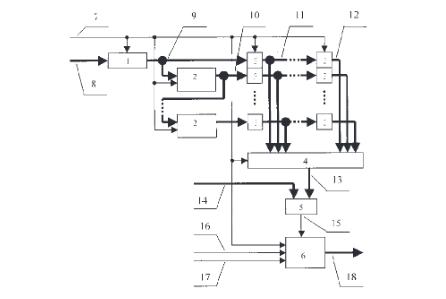
Digitālu pelēko toņu attēlu analizators, kas ieejās saņem attēla katra pikseļa gaišumam atbilstošu paralēlo kodu, pikseļu un rindu taktsignālus un satur filtru mainīgā fona izslēgšanai, kas atšķiras ar to, ka ir paredzēts vienlaicīgai attēla r rindu nepārtrauktai analīzei pa r x r pikseļu izmēra attēla fragmentiem un satur: r-1 virknē slēgtas FIFO tipa operatīvās atmiņas, kuru garums sakrīt ar pikseļu skaitu attēla rindā; r x r pikseļu paralēlā koda reģistrus; aritmētisko operāciju moduli, kas nepieciešams attēla fragmentu pikseļu kovariāciju raksturojošā koeficienta aprēķināšanai katram analizējamajam attēla fragmentam; koda komparatoru aprēķinātā koeficienta salīdzināšanai ar uz prakses pamata izvēlētu līmeni, lai attēlā atklātu par fonu tumšākus apgabalus, kas norāda uz svešķermeņu klātbūtni kontrolējamajā objektā; trauksmes signālierīci, kas bloķē iespējamos neīstos trauksmes signālus, kas var rasties analizējot ikvienas attēla rindu grupas pēdējos r-1 pikseļus, kad kopā ar šiem pikseļiem analizēti tiek nākamās jaunās attēla rindu grupas pirmie pikseļi, kas ģeometriski atrodas attēla pretējā pusē.
http://www.lrpv.gov.lv/sites/default/files/media/vestnesis/20090820.pdf
2009 LR patents Nr. 13857
Digitālu rentgena attēlu analizators svešķermeņu atklāšanai objektos reālā laika režīmā
Inventors:I.Mednieks, A.Skaģeris
Description and link
View the patent on Espacenet(opens in a new window)LR patents Nr. 13857 “Digitālu rentgena attēlu analizators svešķermeņu atklāšanai objektos reālā laika režīmā”. Izgudrotāji: I.Mednieks, A.Skaģeris. Īpašnieks: Elektronikas un datorzinātņu institūts. Publicēts 20.03.2009.
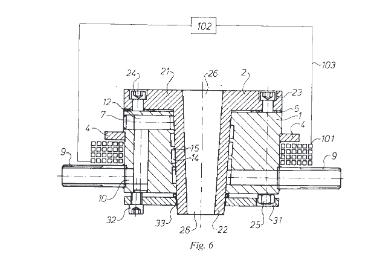
1. Bronzas nepārtrauktās liešanas elektromagnētiskais kristalizators, kas atšķirīgs ar to, ka korpusa (1) centrālajā atverē caur tā izeju (22) ir ievietots konusveida ieliktnis (2), starp ieliktņa (2) cilindrisko izeju (21) un korpusa (1) augšējo virsmu ir ievietots korķis (5), korpuss (1) un ieliktnis (2) ir savienoti ar skrūvēm (24) un uzgriežņiem (25), pie kam uz korpusa (1) apakšējās daļas caur "O" veida gredzenu (6) ir uzstādīts vāciņš (3) un piestiprināts ar skrūvēm (32), korpusa (1) ejā (41) ir ievietots gredzens (4) un piestiprināts korpusam (1), turklāt caurumos (8) ir uzstādīti savienojumi (9) un piemetināti korpusam (1).
2. Bronzas nepārtrauktās liešanas elektromagnētiskais kristalizators saskaņā ar 1.punktu, kas atšķirīgs ar to, ka starp savienojumiem (9) un gredzenu (4) ir izvietoti daudzi induktora (101) vijumi, kuri caur vadītājiem (103) ir savienoti ar invertoru (102).
3. Bronzas nepārtrauktās liešanas elektromagnētiskais kristalizators saskaņā ar 1.punktu, kas atšķirīgs ar to, ka šķērsprofilu diametri D2 un D1 atrodas aptuvenā attiecībā D2:D1 = 1:(3,9 līdz 1,77), šķērsprofilu diametri D4 un D3 atrodas aptuvenā attiecībā D4:D3 = 1:(1,684 līdz 1,262), bet garumi L2 un L1 garums atrodas aptuvenā attiecībā L2:L1 = 1:(1,208 līdz 1,16).
4. Bronzas nepārtrauktās liešanas elektromagnētiskais kristalizators saskaņā ar 1.punktu, kas atšķirīgs ar to, ka korpusa (1) centrālajā atverē ir izveidotas spirālveidā izkārtotas ribas (15), kuras savā starpā veido spirālveida kanālus (14), un ar to, ka korpusā (1) izveidoti caurumi (8, 10, 11, 12, 13), pie kam caurumi (11, 12) ir noslēgti ar necaurejošu korķi (7), kas piemetināts korpusam (1).
5. Bronzas nepārtrauktās liešanas elektromagnētiskais kristalizators saskaņā ar 1. punktu, kas atšķirīgs ar to, ka konusveida ieliktnī (2) ir izveidota centrālā konusveida atvere (26), bet cilindriskajā izejā (21) ir izveidotas daudzas atveres (23).
6. Bronzas nepārtrauktās liešanas elektromagnētiskais kristalizators saskaņā ar 1.punktu, kas atšķirīgs ar to, ka apakšējā vāciņā (3) ir izveidota centrālā atvere (33), kā arī liels skaits apļveida atveru (31) un liels skaits apļveida atveru (34).