
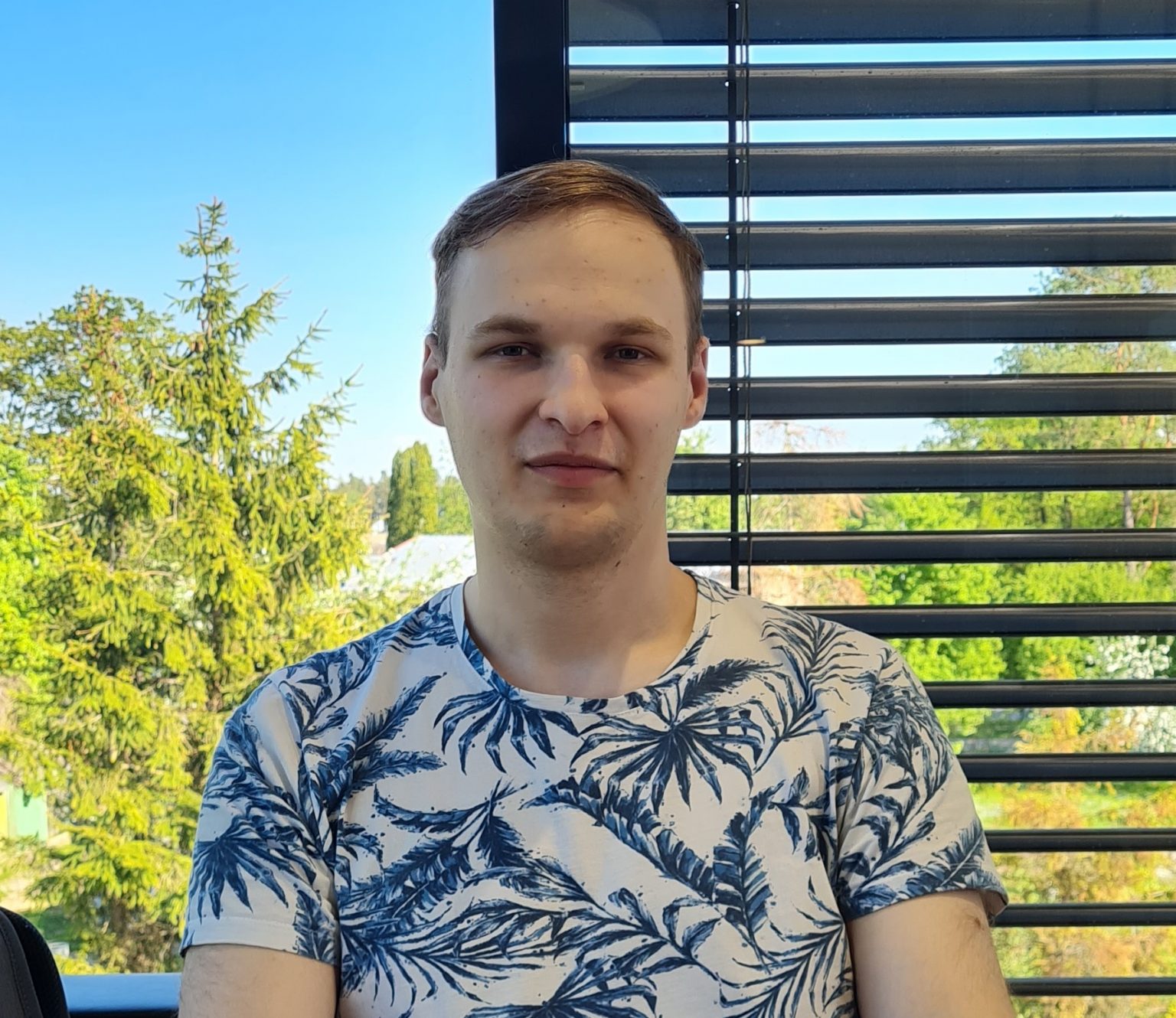
Dans Laksis
Mg.sc.ing.
Former EDI research assistant
Dans Laksis has been working at the Institute of Electronics and Computer Science since 2021 when he obtained a Bachelor's degree in Electrical Engineering from Riga Technical University. In 2023, Dans also earned a Master's degree in Electronics from Riga Technical University. He has studied one semester in the Erasmus+ exchange program at Hamburg University of Technology (TUHH) in Germany. His main areas of expertise are discrete signal processing and analysis, data processing and electronics design. Dans has experience in programming with Python and C languages, as well as working with Altium Designer.
Related publications:
- “About Simultaneous Information and Power Transfer in WSN using Frequency Modulation” (2021) Anna Litviņenko, Romāns Kušņins, Artūrs Āboltiņš, Jānis Eidaks, Dans Laksis, Jurijs Sadovskis.
- “Signal Waveform Impact on RF-DC Conversion Efficiency for Different Energy Harvesting Circuits” (2021) Jānis Eidaks, Romāns Kušņins, Dans Laksis, Ruslans Babajans, Anna Litviņenko.
- “Line-Like Object Detection in Corrupted Images by Averaging of Second Order Vector Fields” (2021) Mihails Pudžs, Artūrs Āboltiņš, Sandis Migla, Oskars Šēlis, Pauls Ēriks Šics, Dans Laksis, Anna Litviņenko.
- “Evaluation of Materials and Structures with a Multistatic Ultra-Wideband Impulse Radar: A Concept Validation” (2023) Gatis Gaigals, Romans Maliks, Vladimir Aristov, Rolands Savelis, Janis Simanovics, Eduards Lobanovs, Haralds Egliens, Dans Laksis, Kristaps Maris Greitans, Modris Greitans.
Projects
5 results
- One Step Open DBL solution (openDBL) 01.01.2023 – 31.12.2025 Completed
- Comprehensive assessment of the condition of bone and muscle tissues using quantitative ultrasound (BoMUS) 03.01.2022 – 30.12.2025 Completed
- AI-based analysis of multi-static UWB-IR radar signals for non-destructive estimation of materials and structure (MIRSA) 01.12.2020 – 31.12.2021 Completed
- Contactless ice thickness measurement device (EDI-ICE) 01.04.2020 – 30.09.2020 Completed
- Automated railway level crossing control system (PAKS) 01.04.2020 – 30.09.2020 Completed
Publications
- 2024
A Comprehensive Review of Sensor-Based Smart Building Monitoring and Data Gathering Techniques(opens in a new window)
Ingrida Lavrinovica, Janis Judvaitis, Dans Laksis, Marija Skromule, Kaspars Ozols
Applied Sciences, Vol. 12 (21), MDPI
Abstract
In an era where buildings are increasingly becoming multifaceted entities, the paradigm of smart buildings has witnessed significant evolution. This advancement integrates sophisticated communication technologies, the Internet of Things (IoT), artificial intelligence (AI), and data analytics. Intending to design an effective smart building monitoring system, this research paper explores and compares various solutions for measuring building parameters by identifying a broad spectrum of review articles considering building occupant behavior, sensor deployment, and implementation complexity. The objective of our paper is to compile diverse information on various sensors used for monitoring building conditions and provide a comprehensive overview of data structuring and processing, all within a single article. Additionally, this paper addresses the challenges of combining data from decentralized systems and the need for managerial tools to optimize user experiences. The findings contribute to the advancement of smart building management, offering valuable insights for improving building performance and user experience as well as evaluating future research directions in this field. This review is designed to serve as an introduction for anyone venturing into the field of building monitoring.
Indexed in Scopus / WoS · Scopus percentile: 79
- 2024
Wavelet transform based decomposition of ultrasound signals for cortical bone model evaluation
Laksis Dans, Tatarinovs Aleksejs, Freivalds Kārlis
EUSIPCO 2024 32nd EUROPEAN SIGNAL PROCESSING CONFERENCE, p. 1496-1500
Abstract
With the global population aging, there is a growing demand for precise, cost-effective, and accessible methods to assess cortical bones for diagnosing degenerative bone conditions like osteoporosis. This article delves into innovative techniques for decomposing ultrasound signals to enhance current state-ofthe-art methodologies. Our approach focuses on deriving quantitative parameters for evaluating bone model characteristics. Utilizing ultrasound scans of bone model surfaces, acquired signals undergo continuous wavelet transform. Subsequently, we extract two key parameters pertinent to bone models: cortical speed of sound and cumulative magnitude sum. Through this methodology, we aim to contribute to advancements in the assessment of cortical bone health.
Indexed in Scopus / WoS
- 2023
Evaluation of Materials and Structures with a Multistatic Ultra-Wideband Impulse Radar: A Concept Validation(opens in a new window)
Gatis Gaigals, Romans Maliks, Vladimir Aristov, Rolands Savelis, Janis Simanovics, Eduards Lobanovs, Haralds Egliens, Dans Laksis, Kristaps Maris Greitans, Modris Greitans.
Applied Sciences, Vol. 13 (3), p. 1636, MDPI
Abstract
This document describes the results of the study contributing to the methods and tools applicable in plastic waste sorting systems that exploit the multistatic ultra-wideband impulse radar enforced with a deep learning signal processing back-end. The novelty of the research is the use of synthetic data for the development of a trained neural network before real data are available, and the use of a multistatic radar for the improvement of the training data set. The study results are described in multiple publications; the current paper shows the applicability of the described approach. The main results are as follows: a monostatic impulse radar can be used for the determination of material properties, such as thickness, dielectric permittivity, and losses, with limited accuracy; multistatic radar configuration increases the accuracy of the material property estimation; an open source finite difference time domain simulator can be used to simulate electromagnetic wave propagation in dielectric structures in order to generate synthetic data for development of optimized artificial neuron network structures used for the estimation of dielectric material properties, and the developed network can successfully be used for multistatic radar data processing.
Scopus percentile: 73 · SNIP: 1.026