
Integrated circuits and systems laboratory
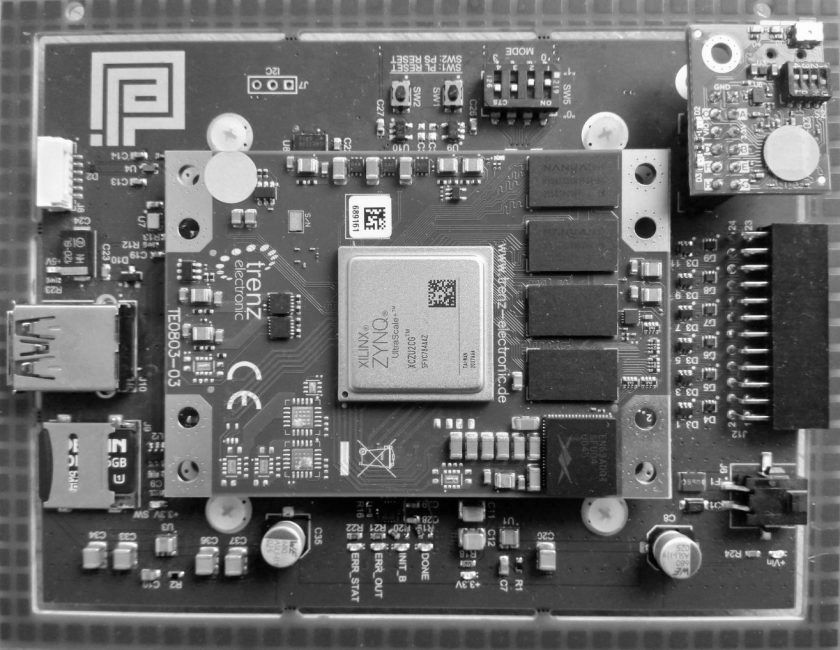
ICS Laboratory excels in high-performance and real-time signal processing, digital circuit design, development of novel sensor technology, heterogeneous single-chip systems, embedded systems for computer vision, development of machine learning algorithms, on-chip architectures, development of operating systems, etc.
Our vision is to build transformative, widely adopted semiconductor technologies that enable innovative industries while facilitating a core value of unlocking the potential of each individual.
We believe that by advancing research and investing in integrated circuits and systems, we will be able to create new approaches to computing, thereby ensuring sustainable societal development and simultaneously strengthening the institute's and Latvia's competitiveness globally.
Laboratory Team
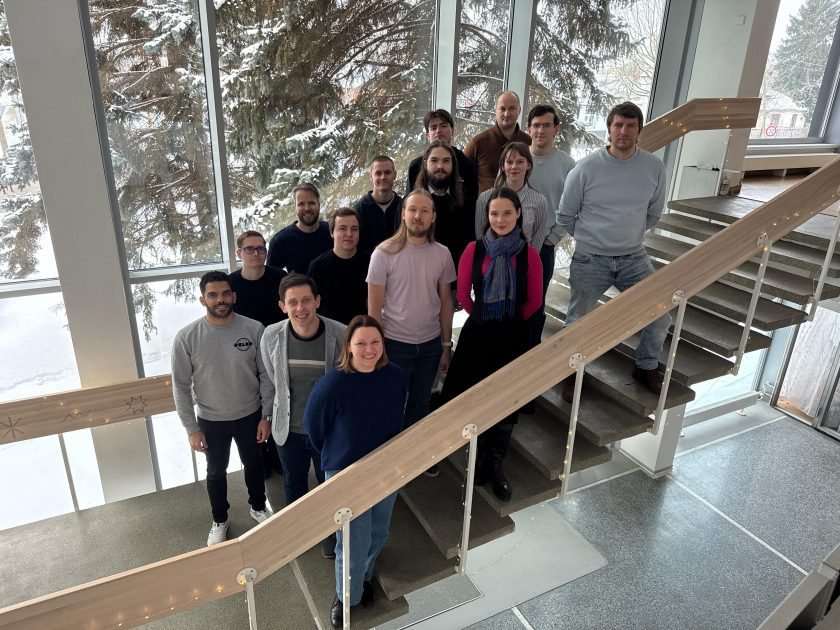
Colleagues (from left): Front row – Z. Sērmaukša, A. Kušņina, A. Bizuns; second row – R. Novickis, A. Cvetkovs, K. Tupule; third row – I. Sayed, M. Meļņiks, M. Pakalns, S. Umnovs; back row – E. Lielāmurs, M. Celitāns, M. Ratniks, N. Nadziņš, G. Šūpols.
Long-term high-level goals of the laboratory:
- Invest in human capital, attract new talents and develop research excellence to promote world-class competence in the field of semiconductor devices and transform Latvia's high-tech sector;
- Create innovations that exceed existing standards in microchip technologies, thereby contributing to the growth of the European innovation and research ecosystem and indicating new directions in scientific progress.
Hardware-accelerated quantum sensor prototype for magnetic field measurement displayed at EFECS2024 and developed collaborativelly with FAU and Arquimea Research. (A-IQ Ready)
FPGA-based infrared image pre-processing and IR/RGB registration prototype. (APPLAUSE)
360-degree full-surround Time-of-Flight perception system for slow speed automotive use cases.
Research directions:
- Development of the next generation sensors
The ability to perceive is a core element of almost any cyber-physical system. Furthermore, new sensing capabilities can significantly improve future technologies' reliability, safety and functionality. However, obtaining such sensing modalities is a complex task requiring cross-domain expertise. These next-generation sensors often require a particular approach to data processing, achievable by developing specialized silicon hardware (chip) solutions.
Our proposition is grounded in our unique, difficult-to-pick-up skills (digital circuit design, digital signal processing, low-level programming, and System-on-Chip devices). Consequently, with our long-term skill investments, we wield a set of technological abstractions well-suited for developing new State-of-the-Art sensors. Our expertise in digital circuit design and on-chip architectures permits us to establish sensor control and data pre-processing at a very low level, while our system and application-level embedded software expertise enables us to increase technology readiness level while providing efficient interfacing for real-world applications. Accordingly, we have established cooperation with physicists, who are skillful at wielding basic physical phenomena to develop sensing capabilities. We complement their skills by further advancing the technology and integrating it into a variety of use cases, basically bridging the gap towards the industry.
Over the years, we have designed and developed different perception systems, including stereo depth cameras, 360-degree surround Time-of-Flight camera-based system, control and pre-processing for a low-cost infrared camera, with our latest being the development of a quantum sensor for magnetic field measurement. The sensor is complex. It incorporates analogue electronics for generating and sampling microwaves, digital electronics for pre-processing and control, and application-level software for users.
- Artificial Intelligence in Heterogeneous Single-Chip Systems
Our active involvement in machine vision research, combined with expertise in microchip digital circuits design, provides the necessary foundation for the developing artificial intelligence accelerators. The interpretation of large volumes of structured and unstructured data has become integral in modern information technology. However, traditional von Neumann architecture struggles to efficiently handle the computational demands of machine learning algorithms.
To address this, heterogeneous single-chip systems enable the integration of AI-optimized computing directly into silicon hardware. Leveraging the latest advancements in machine vision, our laboratory develops digital computing circuits within single-chip systems, achieving ultra-low-power, real-time machine learning capabilities. Our customized Neural Processing Units (NPUs), implemented in reconfigurable FPGA fabric, solve unique challenges such as Spiking Neural Network (SNN) acceleration.
This low-power, high-efficiency approach to large-scale data interpretation has significant applications in battery-operated devices, including drones, mobile robotics and electric vehicles. We are developing advanced algorithms to process transient data from emerging vision technologies, including event cameras, next-generation MIMO radars and ToF sensors. Our aim is to enhance the intelligence of next-generation vision sensor systems.
- Computing accelerators and their integration
The ability to implement algorithms in digital logic gives a unique opportunity to improve almost any modern technology. However, the development of silicon hardware solutions is relatively more expensive than conventional software development, as it requires more extensive training of specialists, prolonged technology development and testing cycles, and the need to integrate the technology with the rest of the system. The laboratory manages a variety of technological abstractions, including electronics design, digital circuit design, operating system engineering, driver development, software development, algorithm creation and even complete system design. These skills give the unique opportunity for accelerator transfer to the industry. Therefore, the ICS laboratory maintains a solution for integrating accelerators into technologies based on conventional hardware (more information: https://www.edi.lv/en/solutions/silhouse-accelerate-your-computer-vision-solution/).
Key words
- development of novel sensors
- signal processing
- smart sensors
- embedded intelligent systems
- digital circuits
- acceleration
- parallel data processing
- real-time
- HSoC, SoC, FPGA
- quantum sensing
Key personnel




Projects
11 results
- Intelligent, Safe and Secure Connected Electrical Mobility Solutions: Towards European Green Deal and Seamless Mobility (EcoMobility) 01.05.2023 – 30.04.2026 Completed
- Trusted lifetime in operation for a circular economy (ARCHIMEDES) 01.05.2023 – 30.04.2026 Completed
- Artificial Intelligence using Quantum measured Information for realtime distributed systems at the edge (A-IQ Ready) 01.01.2023 – 31.12.2025 Completed
- Go IT! 01.09.2022 – 31.08.2025 Completed
- Silicon IP Design House (SilHouse) part 2 01.01.2021 – 30.06.2022 Completed
Publications
- 2023
Infrared Image Pre-Processing and IR/RGB Registration with FPGA Implementation(opens in a new window)
Edgars Lielāmurs, Andrejs Cvetkovs, Rihards Novickis, Kaspars Ozols
Electronics, Vol. 12 (4), p. 4, MDPI
Abstract
Infrared imaging sensors are frequently used in thermal signature detection applications in industrial, automotive, military and many other areas. However, advanced infrared detectors are generally associated with high costs and complexity. Infrared detectors usually necessitate a thermoelectric heater–cooler for temperature stabilization and various computationally complex preprocessing algorithms for fixed pattern noise (FPN) correction. In this paper, we leverage the benefits of uncooled focal plane arrays and describe a complete digital circuit design for Field Programmable Gate Array (FPGA)-based infrared image acquisition and pre-processing. The proposed design comprises temperature compensation, non-uniformity correction, defective pixel correction cores, spatial image transformation and registration with RGB images. When implemented on Xilinx Ultrascale+ FPGA, the system achieves a throughput of 30 frames per second using the Fraunhofer IMS Digital 17 μm QVGA-IRFPA with a microbolometer array size of 320 × 240 pixels and an RGB camera with a 1024 × 720 resolution. The maximum ratio of the standard deviation to the mean of 0.35% was achieved after FPN correction.
Indexed in Scopus / WoS · Scopus percentile: 60 · SNIP: 1.01
- 2020
Functional architecture for autonomous driving and its implementation(opens in a new window)
R. Novickis, A. Levinskis, R. Kadikis, V. Fescenko, K. Ozols
Proceedings of the Biennial Baltic Electronics Conference, IEEE Computer Society
Abstract
It is predicted that due to such technology-driven trends as electrification, connectivity, autonomous driving and diverse mobility, the automotive market will reach a size of 6.7 trillion USD in 2030. Nevertheless, the composition and architectures of the future autonomous vehicles are still unsettled due to the continuous advancement of sensors and computing hardware, availability and interpretation of new data and safety requirements. Given the existing architectures of the autonomous systems, there is a lack of start-To-end depiction of the self-driving car design and components. This scientific article aspires to serve as a starting guide and boilerplate for the evolution of future architectures of such autonomous systems. The article summarizes the previous research in the field, describes the overall hardware and software composition of the EDI Drive-by-Wire car and investigates the components of the autonomous system: data acquisition, perception algorithms, chosen hardware, software component management, vehicle interfacing, approach to failsafe and fail-operational functionalities. © 2020 IEEE.
Indexed in Scopus / WoS
- 2020
Bird's-eye view image acquisition from simulated scenes using geometric inverse perspective mapping(opens in a new window)
D. Justs, R. Novickis, K. Ozols, M. Greitans
Proceedings of the Biennial Baltic Electronics Conference, IEEE Computer Society
Abstract
echnology advancement, major investments, and mainstream interest have reignited the prospect of autonomous driving, nevertheless, the achievement of reliable perception is still an active research topic. This article examines a technique for simplifying path planning and control algorithms by reducing spacial dimensions to two, i.e. by acquiring a Bird's-Eye View (BEV) image. This article aspires to facilitate novel perception fusion approaches by specifying a geometric approach for inverse perspective mapping (IPM), construction of composite BEV of the vehicle, giving suggestions for implementation and proposing a coherent, BEV-based approach for perception fusion. The proposed geometric IPM approach for BEV image acquisition is suited for simulated environments with limited knowledge of the camera's intrinsic parameters. © 2020 IEEE.
Indexed in Scopus / WoS
- 2020
An Approach of Feed-Forward Neural Network Throughput-Optimized Implementation in FPGA(opens in a new window)
Rihards Novickis, Daniels Jānis Justs, Kaspars Ozols and Modris Greitāns
Electronics journal, Vol. 9 (12), p. 1 - 16, MDPI AG
Abstract
Artificial Neural Networks (ANNs) have become an accepted approach for a wide range of challenges. Meanwhile, the advancement of chip manufacturing processes is approaching saturation which calls for new computing solutions. This work presents a novel approach of an FPGA-based accelerator development for fully connected feed-forward neural networks (FFNNs). A specialized tool was developed to facilitate different implementations, which splits FFNN into elementary layers, allocates computational resources and generates high-level C++ description for high-level synthesis (HLS) tools. Various topologies are implemented and benchmarked, and a comparison with related work is provided. The proposed methodology is applied for the implementation of high-throughput virtual sensor. © 2020 by the authors. Licensee MDPI, Basel, Switzerland.
Q1/Q2 journal · SNIP: 0.985