
Space technology laboratory
Laboratory was founded in 1976, providing R&D activity related to high-precision time measurement and custom designs of application-specific time measurement systems providing the highest precision available at that time. Up to the beginning of 1990s several large-scale R&D projects have been completed, about 40 inventions made and about 250 papers published. Currently Lab staff consists of 13 researchers with various specializations (theory of signal processing, electronic engineering, programming, switching circuit design, etc), including 7 specialists with doctoral degree.
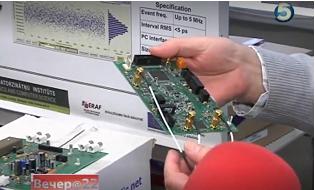
Research in the area of DASP technology in 1990 – 2000th has led to a innovative DSP-based technology for the high-precision event timing. The DSP-based approach developed under the leadership Yury Artyukh not only provides for excellent performance characteristics of event timers but it also leads to almost full replacement of the highly specialized hardware by typical DSP facilities, reducing the hardware implementation cost. A family of Riga Event Timers was developed and made on the basis of this approach. An attractive price-performance ratio makes these instruments quite competitive as compared to the other instruments similar in functionality and quality. These Event Timers are widely used around the world in KHz Satellite Laser Ranging and provide the millimetre ranging accuracy.
In 2011 on the base of Licensee Agreement the rights for manufacturing and distributing of A033-ET are transferred to Eventech Ltd (Latvia). Up to now Eventech has sold more than 60 A033-ET to USA, China, Germany, Finland, England, Austria, Poland, Lithuania, Russia, Korea, Japan. Eventech carries out the market research of application of event timers, not only in Satellite Laser Ranging but also in other fields of science and technology and has found their application in gravimetry, 3D-scan systems, TOF-spectrometry and others.
Accordingly to the current Lab activity, there are three basic R&D directions, each provided by stand-alone scientific group respectively:
- Development of innovative technologies for High-precision Event Timing
- Development of technology for Digital Alias-free Signal Processing
- Development of image processing algorithms and their implementation
Among the common-used facilities, the Lab is well equipped by specialized high-performance instrumentation just for the noted researches. Basically the Lab activity is funded in the framework of national R&D programs. In addition, specific scientific services and products available on contract basis are offered.
Assigned patents
Interpolācijas metode “laiks-kods” pārveidošanai
Interpolācijas pārveidotāja “laiks-kods” kalibrēšanas metode
Precīzo ģeneratoru perioda džitera novērtējuma metode
Интерполятор для преобразования “время-код” с малым мертвым временем
LR patents LV 14691. “Monostabils multivibrators”. Izgudrotāji: V. Bespalko, A. Mezeriņš.
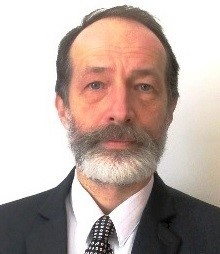
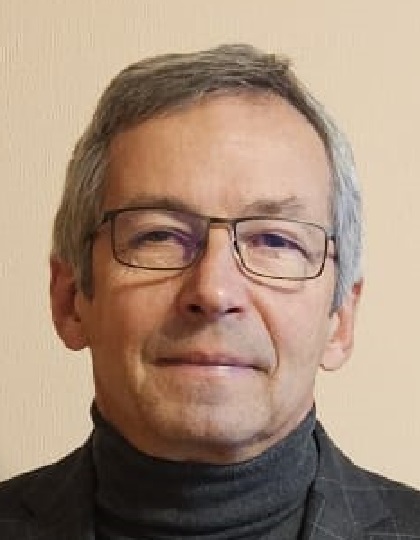
Key personnel



Projects
10 results
- High precision synchronous timing in widely distributed scientific instrumentation (DaLaS) 01.03.2017 – 29.02.2020 Completed
- On-board implementation of the multi-purpose Event Timer (MPET) 01.02.2016 – 31.12.2017 Completed
- Universal time event recorder for SLR, LiDAR and 3-D scan applications (LaReg) 01.01.2014 – 30.06.2015 Completed
- Experimental development of Multi-functional Time Analyser (SiLA) 01.01.2011 – 31.12.2013 Completed
- DASP pielietojumu pētījumi konkurētspējīgu virtuālo instrumentu izstrādei 01.07.2006 – 30.06.2008 Completed
Publications
- 2019
Estimating the Precision of a Leading-Edge Discriminator with Amplitude Correction(opens in a new window)
V. Bespaļko, I. Burak, K. Salmiņš
Instruments and Experimental Techniques, Vol. 62 (6), p. 788-793, Pleiades Publishing
Abstract
The formation of time stamps that are independent of the sensor output pulse amplitude in the domain of event timing is well-known problem. It is shown that the time-stamp accuracy (time walk) can be estimated using high-speed arbitrary-signal generators and general-purpose time meters with an uncertainty of the estimate of no worse than 0.2 ps. The efficiency of the technique is demonstrated for a leading-edge discriminator (LED). The proposed LED version combined with an amplitude meter and amplitude correction has a 17-ps time walk.
SNIP: 0.763
- 2019
Sampling and Estimating the Waveform of Analog Signals Based on Precision Event Timing(opens in a new window)
A. S. Rybakov
Automatic Control and Computer Sciences, Vol. 53 (2), p. 107–115, Pleiades Publishing
Abstract
In this paper, we investigate specific features of compressed sensing methods when estimating the waveform of arbitrary analog signals based on zero-crossings of a signal summed with a periodic oscillation. An algorithm for estimating the waveform of an analog signal with the adaptation of the basis matrix to its spectrum is proposed. To solve the problem of off-grid frequencies, we employ an iterative method for finding the maxima of the spectral peaks between the nodes of a DFT frequency grid. © 2019, Allerton Press, Inc.
Indexed in Scopus / WoS · SNIP: 0.676
- 2018
Modernization of Event Timer RTS 2006
V.Bespal’ko, K. Salmins, I. Buraks
Abstract
<p>Modernization of Event Timer RTS 2006. V.Bespal’ko, K. Salmins, I. Buraks 21st International Workshop on Laser Ranging, Canberra, Australia, November 04-09, 2018</p> <p><a href="https://cddis.nasa.gov/lw21/docs/2018/presentations/Session8_Salmins_presentation.pdf">https://cddis.nasa.gov/lw21/docs/2018/presentations/Session8_Salmins_presentation.pdf</a></p>
- 2018
Demodulation of Frequency-Modulated Signals by Pseudorandomly Selected Zero-Crossing Instants
A. S. Rybakov.
Abstract
<p>A. S. Rybakov. Demodulation of Frequency-Modulated Signals by Pseudorandomly Selected Zero-Crossing Instants. // Automatic Control and Computer Sciences, 2018, Vol. 52, No. 2, pp. 77–88.</p>
- 2018
“Specific Signal Representation for Transmission and Processing based on Precise Event Timing
I.Mednieks, I.Bilinskis, E.Boole
Abstract
<p>I.Mednieks, I.Bilinskis, E.Boole “Specific Signal Representation for Transmission and Processing based on Precise Event Timing”, 16th Biennial Baltic Electronics Conference (BEC2018), Oct 8, 2018 - Oct 10, 2018 Tallinn, Estonia<br /> Abstract:<br /> Method for signal representation based on using the signal phase at the time instant of the signal and reference function crossing events is proposed and described. Combination of the signal compressive transmission and digital processing, performed before recovery of the input signals, is described.<br /> Focus is on application of this method for avoiding multiple multiplications of two digital variables at digital processing the<br /> signals according to the widely used algorithms. Using the described approach to signal representation and digital processing provides for significant increasing the operational speed at the involved calculations.</p>