
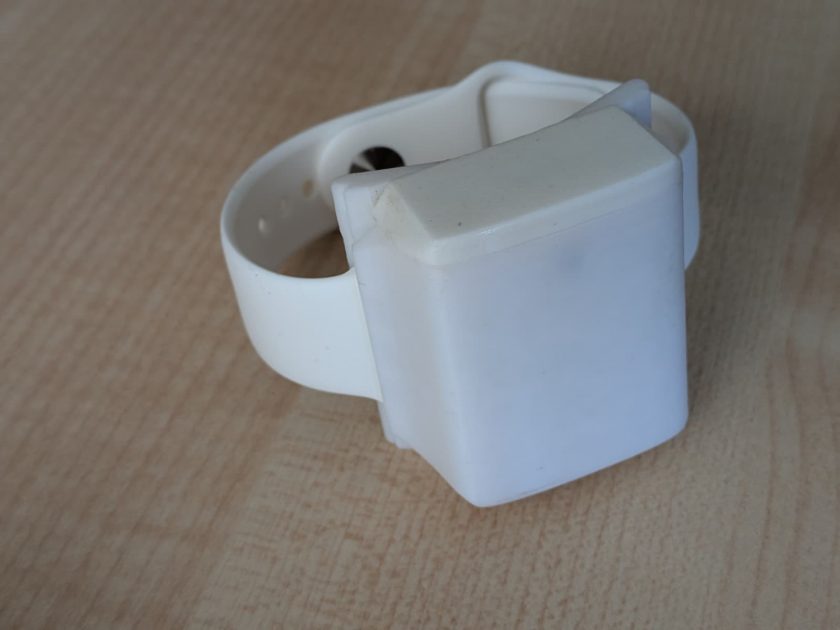
WearEDI_V2 – smart bioimpedance wristband for continuous bioparameter monitoring.
Value Proposition
WearEDI_V2 is a wearable device based on bioimpedance measurements for continuous monitoring of physiological parameters. The system is designed for indirect detection of heart activity, stress, hydration levels, and other biomarkers using bioimpedance analysis and motion sensor data.
The technology employs low-power electronics and advanced signal processing to obtain stable measurements under everyday usage conditions. The WearEDI_V2 platform establishes a foundation for next-generation digital health and preventive medicine solutions.
Key benefits:
- Continuous monitoring of physiological parameters
- Bioimpedance-based heart activity detection
- Potential for dehydration, stress, and metabolic state analysis
- Low power consumption and wearable form factor
- Integrable into research, medical, and digital health solutions.
Business and Innovation Perspective
Challenge
There is a growing demand for continuous health monitoring solutions capable of early detection of physiological changes and health risks. Existing wearable devices are mostly based on optical sensors (PPG), whose accuracy is significantly affected by:
- motion artifacts
- skin properties
- lighting conditions
- sensor positioning
- sweating and external factors.
In addition, many commercial devices provide limited access to raw data and are not suitable for advanced research or specialized medical applications.
Existing Alternatives
Currently, the market is dominated by:
- optical heart rate sensors
- clinical ECG systems
- specialized bioimpedance devices.
Their main limitations include:
- limited accuracy during movement
- high cost
- large form factor
- unsuitability for long-term wear
- insufficient adaptability for research purposes.
EDI Solution and Uniqueness
The WearEDI_V2 platform developed by EDI uses high-frequency bioimpedance measurements combined with inertial sensors and advanced signal processing to obtain stable physiological parameter estimation under real-world conditions.
The system is based on:
- MAX30001 bioimpedance analog front-end
- nRF5340 microcontroller
- IMU for motion analysis
- adaptive digital signal processing
- motion artifact compensation
Signal processing methods used:
-
- baseline removal
- Butterworth and elliptic filtering
- EMD (Empirical Mode Decomposition)
- wavelet denoising
- correlation analysis for heart rate detection
Comparison with typical alternatives
| Parameter | Typical commercial solution | WearEDI_V2 |
| Measurement method | Optical (PPG) | Bioimpedance + IMU |
| Performance during movement | Sensitive to artefacts | Artefact compensation |
| Research flexibility | Limited | Full data access |
| Scalability | Low | Modular architecture |
| Potential biomarkers | Mainly HR | HR, stress, hydration, activity |
| Wearable form factor | Yes | Yes |
| Continuous data | Partial | Yes |
Technology Readiness Level (TRL): TRL 4–5
Technology validated in laboratory and early user testing, demonstrating:
- heart rate detection from bioimpedance signals
- activity classification
- sleep/wake state detection
- reduction of motion artifacts
Intellectual Property Status
- Know-how and algorithmic expertise in signal processing
- Potentially patentable solutions in bioimpedance data interpretation and sensor integration
- Software and data processing architecture developed within EDI framework
Projects
Wearable Bioimpedance Sensing for Prediabetes Research
Project focus:
- early detection of prediabetes risk
- physiological data monitoring
- combination of AI and bioimpedance for digital health solutions
The development involved:
- continuous bioimpedance measurements
- activity classification
- physiological data analysis
- integration of wearable sensors
Technical Specification
Operating principle
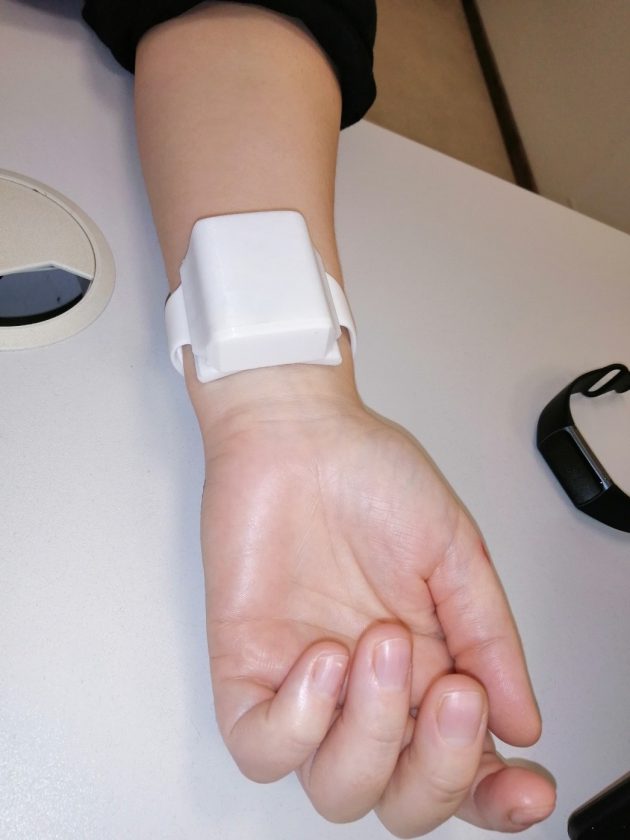
WearEDI_V2 uses high-frequency bioimpedance measurements (~100 kHz range) to analyse the electrical properties of tissues and their changes over time. Impedance variations caused by cardiac activity and other physiological processes are captured via electrodes placed on the wrist area.
The acquired data is:
- filtered
- cleaned from noise
- optionally synchronized with IMU data
- analysed using digital signal processing methods
During testing, the following were demonstrated:
- heart rate extraction from bioimpedance signals
- activity detection
- sleep/wake state classification
- off-wrist detection
Technical parameters
| Parameter | Value / Description |
| Measurement principle | Bioimpedance sensing |
| Bioimpedance AFE | MAX30001 |
| Microcontroller | nRF5340 |
| Additional sensors | ICM-20948 IMU |
| Additional optical sensor | MAX30101 (optional) |
| Bioimpedance frequency | ~100 kHz |
| Data storage | microSD |
| Wireless communication | Bluetooth Low Energy |
| Wear location | Wrist |
| Signal processing | Butterworth, elliptic, EMD, wavelet filtering |
| Heart rate detection | Correlation and peak analysis |
| Activity detection | IMU + bioimpedance |
| Platform | Embedded ARM |
| Power optimization | Low-power architecture |
| Application areas | Digital health, research, preventive medicine |
Collaboration Model
EDI sees several possible technology transfer models:
Licensing
Licensing of bioimpedance technology, algorithms, or IP to manufacturers of medical, health technology, or wearable devices.
Contract research and co-development
Adaptation of the technology to partners’ specific needs:
- health monitoring
- sports analytics
- medical diagnostics
- digital therapy solutions
Joint projects
Participation in:
- Horizon Europe
- Digital Health
- AI in Healthcare
- medtech and wearable technology projects
Technology integration
Integration of the WearEDI_V2 platform into:
- research infrastructure
- clinical studies
- data analytics platforms