
Value Proposition
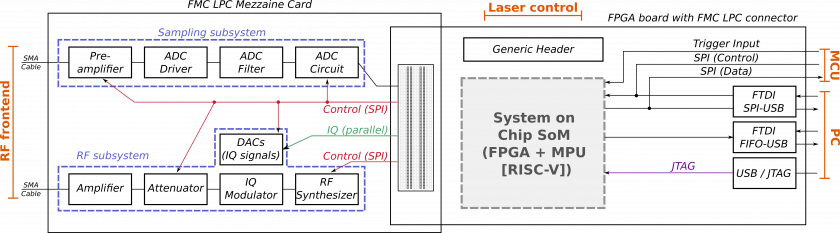
The event-based control and readout platform is primarily developed and intended for quantum sensing applications based on Nitrogen Vacancy (NV) centres in diamonds. These systems require careful orchestration between optics, microwave electronics, readout and processing. However, the platform is generic and could be utilised for various applications with a requirement for precise control. The platform presents an event-based system architecture where components can consume or produce events to trigger specific actions and assist in complex measurement coordination. For this reason, the architecture incorporates an event router and numerous event delay blocks to support timing-based measurement procedures, for example, pulse-based measurements in the context of NV centre diamond quantum sensors.
Business and Innovation Perspective
- Measurement coordination (microwave, laser, acquisition) for quantum sensors based Nitrogen-Vacancy (NV) centres in diamond
- Optically Detected Magnetic Resonance (ODMR)
- Lock-in ODMR
- Sparse lock-in ODMR
- Pulse-based measurement methods, e.g. Hahn echo
- CPMG-n, XY, UDD, PDD, KDD
- Component for quantum sensing-based applications
- GNSS-denied localisation
- Magnetic microscopy
- Anomaly detection using AC magnetic field
Technical Specification
- Modular, event-based control and data-preprocessing architecture
- RISC-V processor for control
- Synthesizer frequency: from 2.2 GHz to 4.4 GHz
- Dual Digital-to-Analogue Converter (DAC) clocked at 100 Mhz
- Analogue-to-Digital Converter (ADC) clocked at 10 MHz
- Pulse position-based laser control
- Embedded processing functionality
- UART-based control at function, block and register levels
- SPI-based raw and processed data output
Additionally, the platform incorporates an embedded RISC-V processor, which provides some processing functionality, coordinates measurements, and implements a UART-based interface for external control. Most notably, the processor delivers control interfacing at three abstraction levels depending on the use case:
- a high-level control to launch the most common measurement procedures for NV centre diamond-based quantum sensors;
- a mid-level control for manipulating individual blocks of the system, for example, to implement custom measurement protocols/applications;
a low-level control for manipulating individual registers for system debugging and to exploit otherwise unexposed configurations.