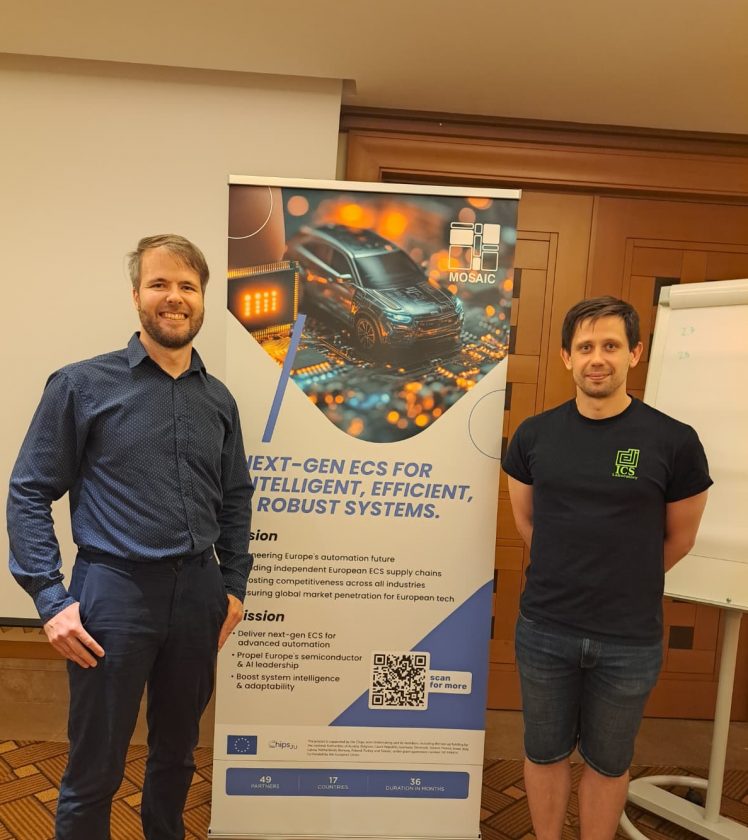
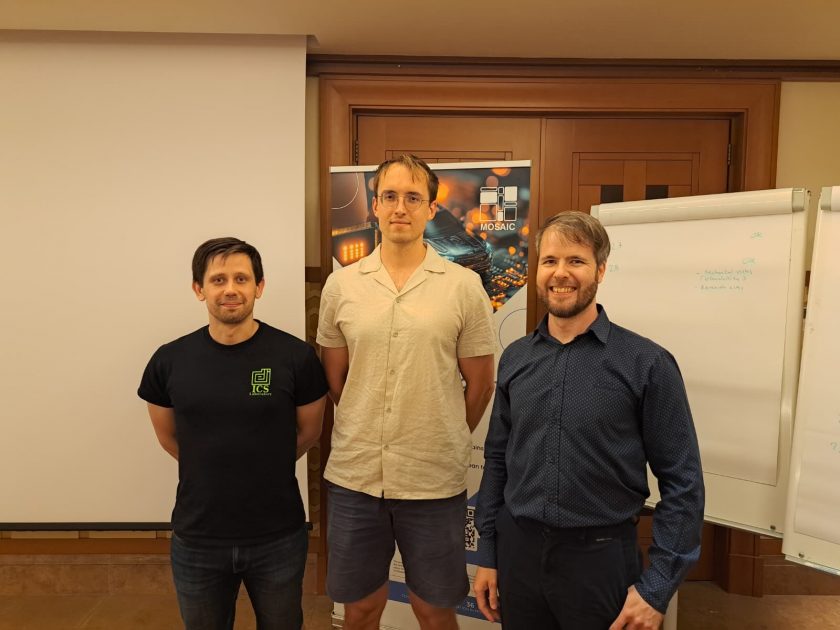
Researchers Rihards Novickis and Maksis Celitāns from EDI participated in the MOSAIC Project General Assembly, representing the Institute of Electronics and Computer Science, where EDI’s role in the project is encompassed by two research directions.
Maksis Celitāns represented the first research direction, which focuses on the development of a real-time cooperative perception system to improve road safety. In this approach, the perception systems of vehicles and infrastructure work together to enhance traffic safety. The infrastructure-based perception system provides drivers with additional information about areas with limited visibility. A key aspect of this system’s development is EDI’s collaboration with Europe’s leading semiconductor company, Infineon Technologies, whose radar technology will be integrated into the system.
Rihards Novickis represented the second research direction, where EDI focuses on the advancement of quantum sensor technology, including leading the development of two technology demonstrators. EDI is developing quantum sensors based on nitrogen-vacancy (NV) center defects in diamonds by creating a miniaturized and low-cost sensor head that has the potential to reduce sensor head costs by a factor of ten (to approximately €400). In addition, EDI is applying this quantum sensor technology to precise non-contact current measurement, where the main challenge is achieving high accuracy across a wide measurement range.
Saistītās saites
More about the project:
- https://www.chips-mosaic.eu
- https://www.edi.lv/en/projects/a-mosaic-of-essential-electronic-components-and-systems-ecs-for-our-automated-digital-future-in-industry-and-mobility-mosaic/
Memorandum of Understanding on the Development of Quantum Technologies in Latvia
EDI’s Integrated Circuits and Systems laboratory: