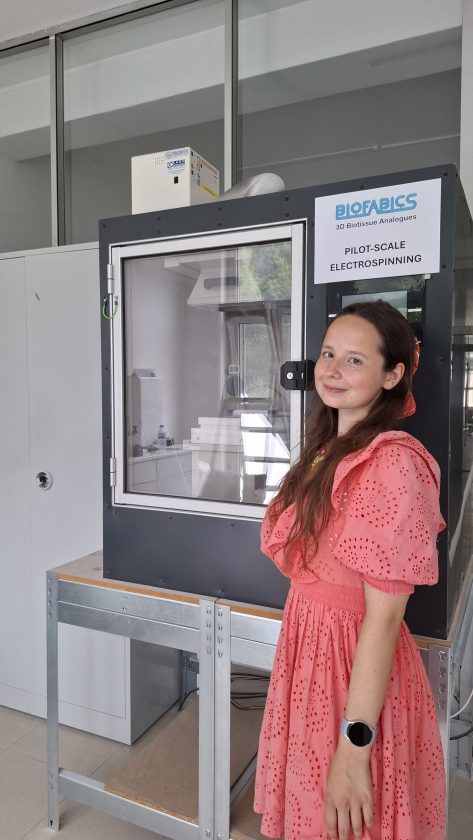
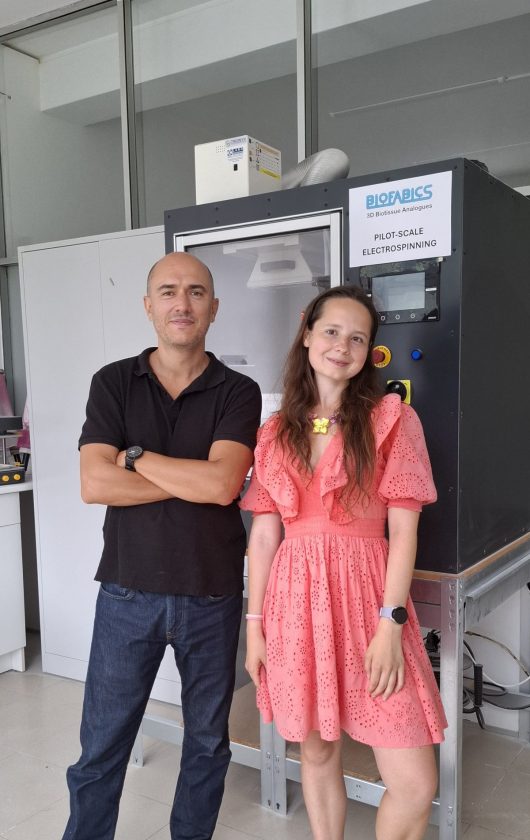
Klara Kuznecova, electronics technician at the Institute of Electronics and Computer Science (EDI) in Riga and BSc student in Electrical Engineering, has successfully completed a one-month secondment at BIOFABICS LDA in Porto, Portugal. The visit was carried out within the EU-funded project ESCULAPE, supported by the Marie Skłodowska-Curie Actions programme.
The secondment focused on biological validation methods for conductive biomaterials, a key component of the ESCULAPE project. During her stay, Klara completed the host laboratory’s onboarding and safety training, and received hands-on training in mammalian cell culture techniques using H9c2 cardiomyoblast cells.
She performed standard viability assays, including MTT and Live/Dead staining, and practised cell adhesion assessment on polymeric scaffolds.
Klara also worked with the lab’s impedance analyser, first learning calibration and electrode placement using commercial electrodes, and later assisting in a cardiac-on-chip experiment where impedance signals from spontaneously beating cardiomyocytes were recorded.
She contributed to data logging, signal stability checks, and basic data visualisation.
A practical output of the secondment is a draft Standard Operating Procedure covering cell viability testing and preliminary impedance monitoring steps.
“The secondment at BIOFABICS gave me the opportunity to learn the biological side of bioelectronics – how to work with living cells, how to assess biocompatibility, and how to measure electrical activity in tissue models. This experience bridges the gap between materials development and real biomedical applications, and I am very grateful to the team for their guidance,” said Klara Kuznecova.
BIOFABICS LDA is a deeptech R&D company specialising in 3D biotissue analogues and organ-on-chip devices for drug discovery, diagnostics, and regenerative medicine.
Their role in ESCULAPE is to provide biological models for testing the functionality and biocompatibility of newly developed conductive biomaterials. The ESCULAPE project aims to develop innovative strategies for electrically conductive biomaterials for tissue engineering, regenerative medicine, and wearable electronics.
Cooperation between Latvian and Portuguese research institutions strengthens Europe’s research capacity and creates a foundation for future joint work.