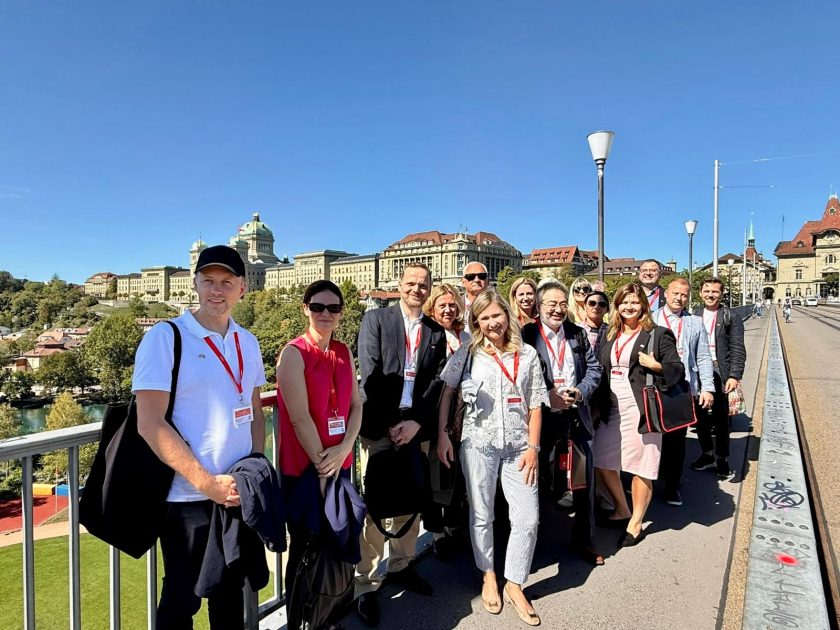
From 14 to 17 September, representatives of Latvia’s public administration, research institutions and industry took part in an experience-exchange visit to Switzerland, including Gints Kučinskis, Coordinator of the LACISE project, and Anna Mutule, LACISE project representative. The visit focused on the commercialisation of research results, technology transfer and building effective collaboration between research and industry.
The Latvian delegation brought together representatives from the Ministry of Education and Science of Latvia, the Ministry of Economics, the Ministry of Finance, the Investment and Development Agency of Latvia, Riga Technical University, the Institute of Solid State Physics of the University of Latvia, the Institute of Electronics and Computer Science, LAU Infra Group, and the Association of the Latvian Chemical and Pharmaceutical Industry.
Over four days, participants gained insight into different stages of the innovation lifecycle – from research policy and funding mechanisms to technology transfer, industry collaboration and the practical application of research results. The delegation met with representatives of the Swiss State Secretariat for Education, Research and Innovation (SERI), the Swiss Innovation Agency Innosuisse and the Swiss National Science Foundation, and visited leading Swiss research and innovation organisations, including the Swiss Center for Electronics and Microtechnology (CSEM), the Paul Scherrer Institute (PSI), Park Innovaare, the knowledge and technology transfer centre ANAXAM, the Zurich University of Applied Sciences (ZHAW), and the Swiss Federal Laboratories for Materials Science and Technology (Empa).
Together, these visits provided insight into different stages of the same innovation chain – from policymaking and funding to industry collaboration, technology transfer and practical application.
From Research Results to Real-World Impact
One of the key takeaways from the visit was that innovation requires more than funding alone. For a scientific idea to develop into a market-ready product or technology, it needs a supportive ecosystem that combines research infrastructure, expert knowledge, prototyping capabilities, technology validation and close cooperation with industry.
The delegation observed this approach in practice across several Swiss institutions. CSEM, for example, develops technologies together with industrial partners; PSI helps research results reach companies; while ANAXAM provides businesses with access to advanced analytical methods and research infrastructure that would otherwise be complex and costly to establish independently.
Particular attention was also given to engaging companies earlier in the research process and creating effective mechanisms for research commercialisation. The Swiss experience demonstrates that successful innovation ecosystems are built on long-term collaboration between science, industry and the public sector.
Gints Kučinskis, LACISE Project Coordinator:
“The visit not only helped strengthen existing partnerships but also provided valuable insight into how Switzerland successfully ensures that innovations developed through research reach industry and deliver tangible benefits to society.”
Strong Ecosystems Drive Technology Transfer
Modris Greitāns, Director of the Institute of Electronics and Computer Science, emphasised the value of learning from Switzerland’s approach to technology transfer and intellectual property management:
“The visits to CSEM, PSI, ZHAW and Empa were an excellent opportunity to see first-hand how Switzerland has built a research and innovation ecosystem that closely connects science, the public sector and industry. It was particularly valuable to see how not-for-profit research institutes based on public-private partnerships operate, as well as how intellectual property management and technology transfer are organised in a straightforward and effective way. Switzerland’s success in fostering the growth of high-tech companies, including innovative SMEs, shows that this approach works. This experience is highly valuable for Latvia – there is much we could learn from and adapt, both in the development of research and innovation policy and in the organisation of institutional cooperation, technology transfer and knowledge commercialisation.”
Valuable Lessons for the Future of LACISE
The visit provided an opportunity not only to compare Latvian and Swiss approaches to innovation, but also to identify issues that are particularly relevant to the goals of the LACISE project: engaging companies earlier in the research process, strengthening cooperation between research organisations and industry, improving technology transfer mechanisms, and ensuring that research results generate tangible value for society and the economy.
For the LACISE consortium, the experience offers valuable insights that can support the project’s continued implementation and strengthen collaboration between Latvian and Swiss research organisations, fostering innovation and accelerating the practical application of research in future energy and technology solutions.
The experience-exchange visit was organised within the framework of the Swiss–Latvian Cooperation Programme “Partnership in Applied Research: Innovative Materials, ICT and Smart Energy”, which promotes cooperation between Latvian and Swiss research institutions in applied research and supports the practical application of research results.
Further information about the programme is available here.
Read the article about the visit on the website of the Ministry of Education and Science of Latvia