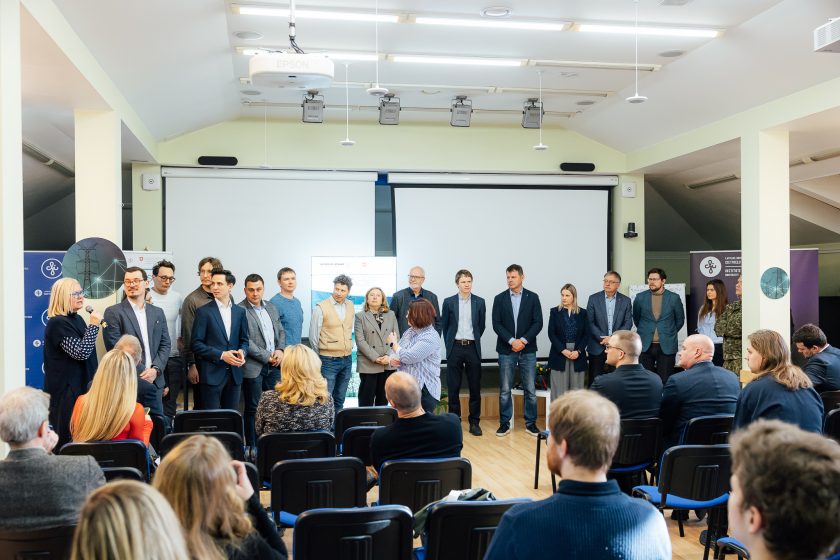
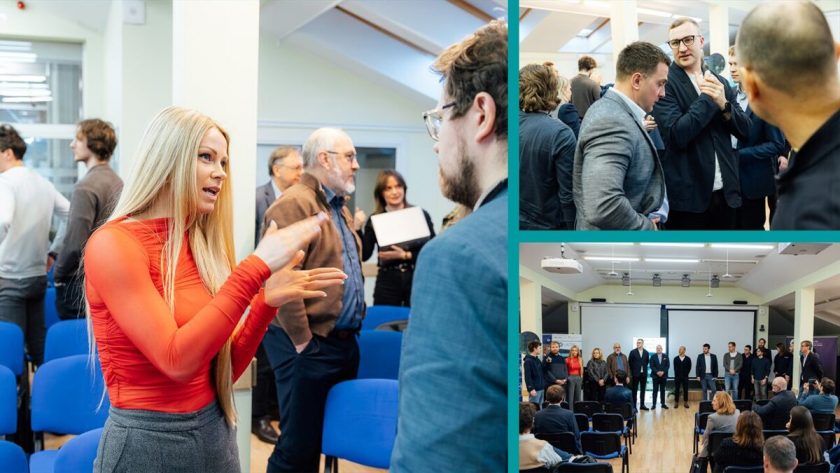
To foster collaboration between science and industry, researchers and representatives from various sectors gathered on Wednesday, 25 February, at the first Battery Industry Day. The event was organized by the Institute of Solid State Physics, University of Latvia and took place within the framework of the LACISE project, which aims to strengthen scientific capacity and promote technology transfer to industry, particularly in smart specialization fields.
Today, batteries play a crucial role not only in energy storage and electromobility, but also in defense and the resilience of critical infrastructure. During the discussions, participants concluded that competing with China in large-scale battery manufacturing would not be realistic for Latvia, given global market concentration, economies of scale, and the dominance of Asian supply chains. However, Latvia has strong potential in developing high value-added solutions — including advanced materials research, battery management systems (BMS), charging technologies, safety solutions, and sustainable recycling processes.
It was noted that existing global battery production capacity is likely sufficient to meet projected demand in the coming years. Nevertheless, significant challenges remain. Representatives from electromobility and renewable energy companies, as well as the defense sector, highlighted several issues: reduced battery performance at low temperatures, underdeveloped recycling systems, technical challenges in battery management systems, and difficulties in attracting funding for start-ups developing new battery technologies.
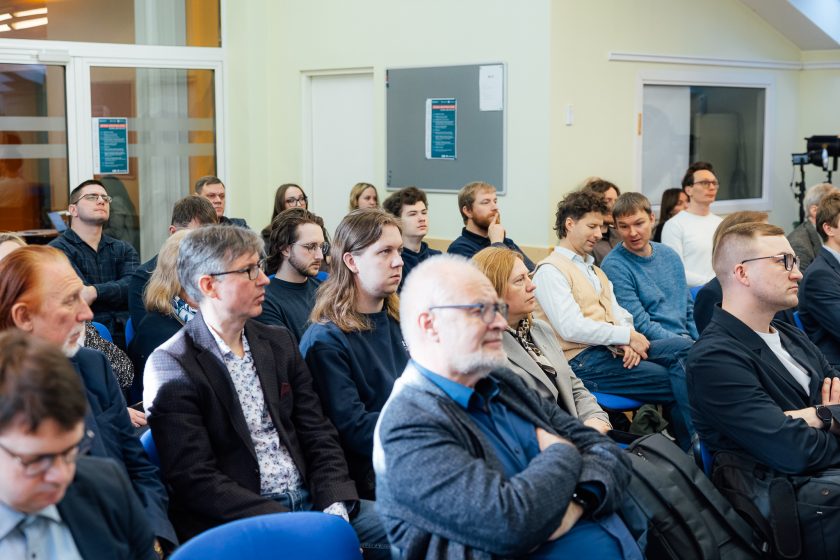
Currently, batteries are not manufactured directly in Latvia. A representative of the energy and communications infrastructure construction company Latvijas Energoceltnieks, Dmitrijs Anisko, stated that developing a manufacturing industry in Latvia capable of competing with large-scale Chinese producers is unlikely. Therefore, the strategic focus should be on technology development and system integration, particularly in the field of battery management and energy flow optimization.
He emphasized that Latvia’s greatest contribution could lie in intellectual value – software and control algorithms that ensure the safe and efficient integration of battery parks into the power system. In Latvia, the transmission system is operated by Augstsprieguma tīkls, electricity generation is carried out by Latvenergo, and distribution to end users is managed by Sadales tīkls. To prevent battery storage systems from disrupting the stable operation of the existing energy system, precise control mechanisms, real-time monitoring, and forecasting tools are required to ensure balancing and capacity management.
Meanwhile, the Autonomous Systems Competence Centre, which brings together the capabilities of the National Armed Forces in the drone sector and private companies, highlighted the importance of batteries in the military domain. Its head, Major Modris Kairišs, stressed that batteries are a critical resource in nearly all drone technologies. For the defense sector, not only innovative batteries with higher energy density and improved safety are important, but also the ability to build up reserves and manage them effectively.
Battery Industry Day, organized within the LACISE project, served as a platform bringing together academia, industry, and the defense sector to define Latvia’s niche in the global battery value chain — not in mass production, but in knowledge creation, innovation, and the development of advanced system-level solutions.
The LACISE project is supported by the Swiss contribution to reducing economic and social disparities in the EU. It is carried out within the Swiss-Latvian Cooperation Programme ‘Partnership in Applied Research,’ under Grant Agreement No LZP/LV-CH-RESEARCH/PC2, implemented by the Ministry of Education and Science and the Latvian Council of Science.