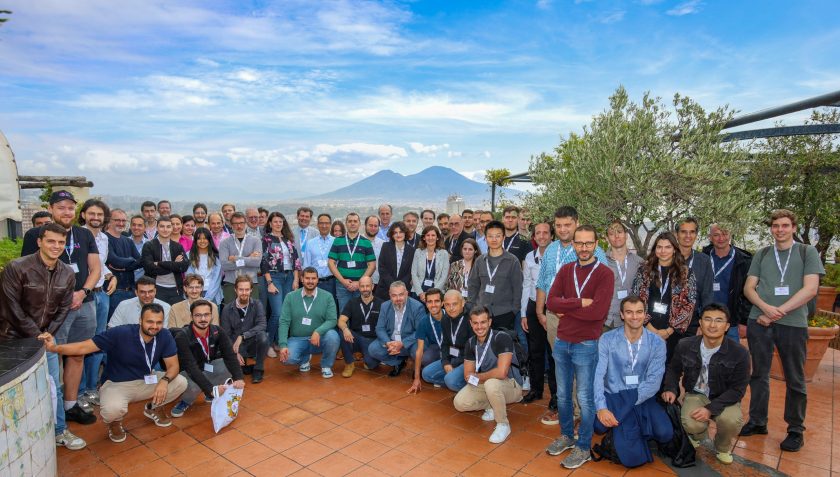
Senior researcher at the Robotics and Perception Laboratory Jānis Ārents, researcher Pēteris Račinskis and programming engineer Tomass Zutis, head of the Cyber-Physical Systems Laboratory and senior researcher Jānis Judvaitis, are attending the EEAI2025 – “European Conference on EDGE AI Technologies and Applications” conference.
On the first day of the conference
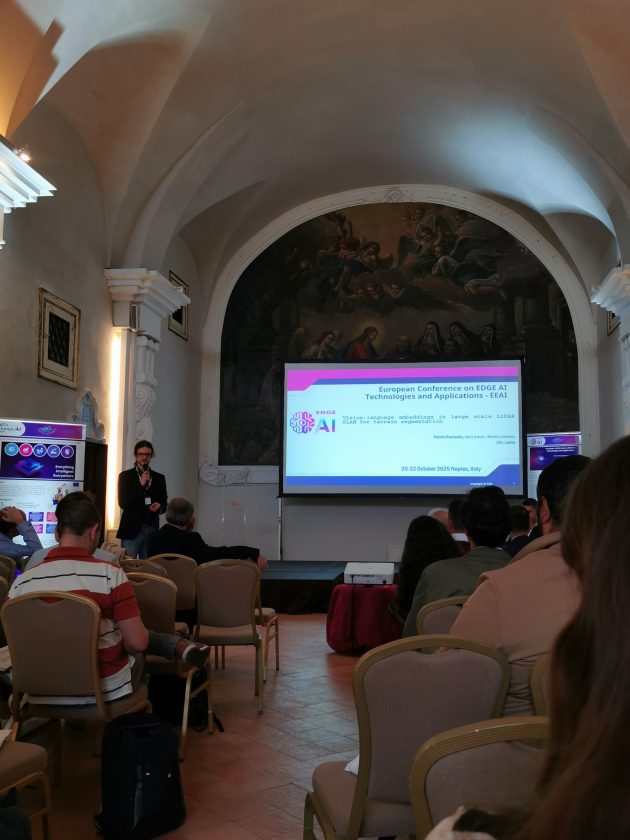
- Pēteris Račinskis presents a paper titled: “Vision-Language Embeddings in Large Scale LiDAR SLAM for Terrain Segmentation” showcasing the potential of open-set semantics in outdoor terrain segmentations through projecting vision-language model embeddings into a large-scale LiDAR occupancy map.
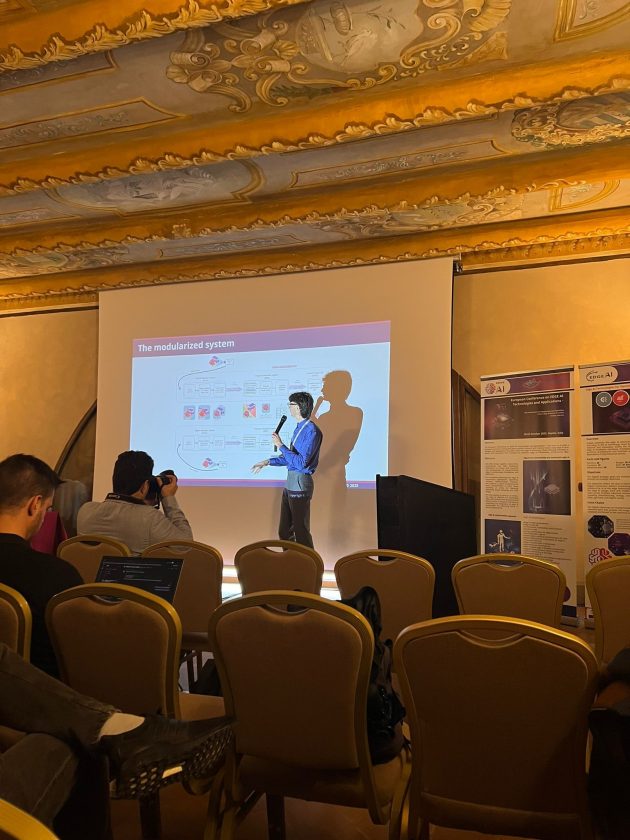
- Tomass Zutis presents a paper titled: “Edge-Optimized Modular Architecture for Real-Time Vehicle Re-Identification” addressing the challenge of real-time vehicle re-identification (Re-ID) on resource-constrained edge devices, with aim to design and deploy a modular, edge-optimized system that integrates object detection and Re-ID for intelligent transportation applications.
Jānis Judvaitis and Jānis Ārents serve as co-chairs for two of the conference sessions, “Session C02: Trustworthy Edge AI” and “Session F03: Modelling and Predictive Control,” introducing the session and the presenters.
The presentations at the EEAI conference delved into optimizing software and technical solutions for Edge devices, parallel development of hardware and software, and sustainability in artificial intelligence applications. These discussions highlight areas gaining increasing significance, such as neuromorphic architectures, federated management of Edge devices, and AI solutions in industrial processes.
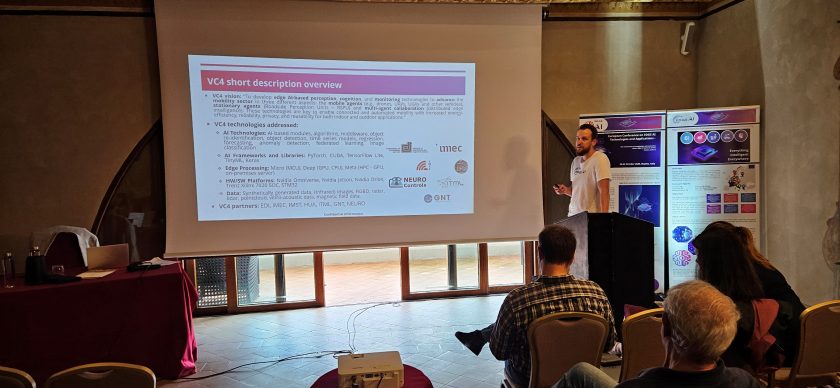
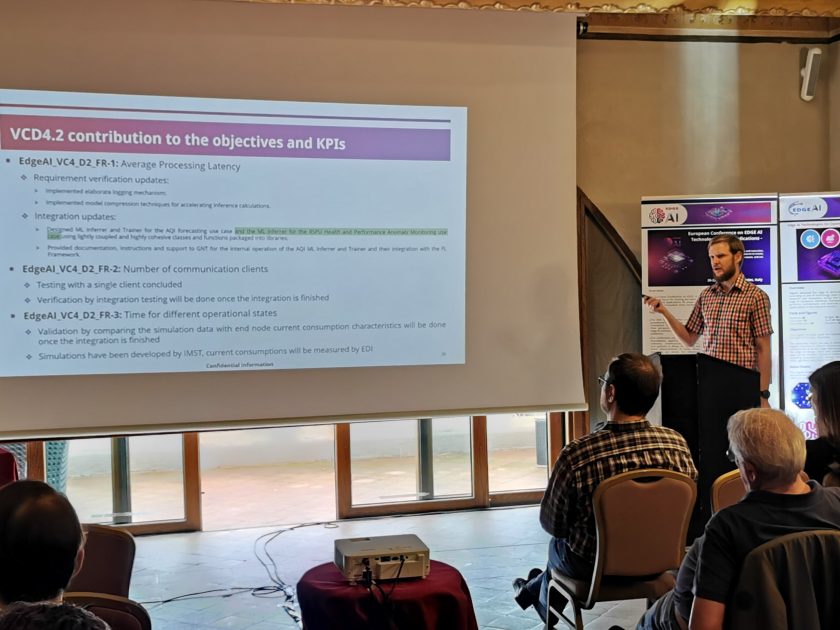
Following the conference, additional event continues at the same location: the Horizon Europe project EdgeAI General Assembly, where Jānis Ārents, and Jānis Judvaitis engage in discussions with other partners about effective collaboration for the project’s next steps. They also present value chain VC4 s“Mobility,” led by EDI, showcasing demonstrators VCD4.1 and VCD4.2. The General Assembly also discusses the project’s progress and future activities.