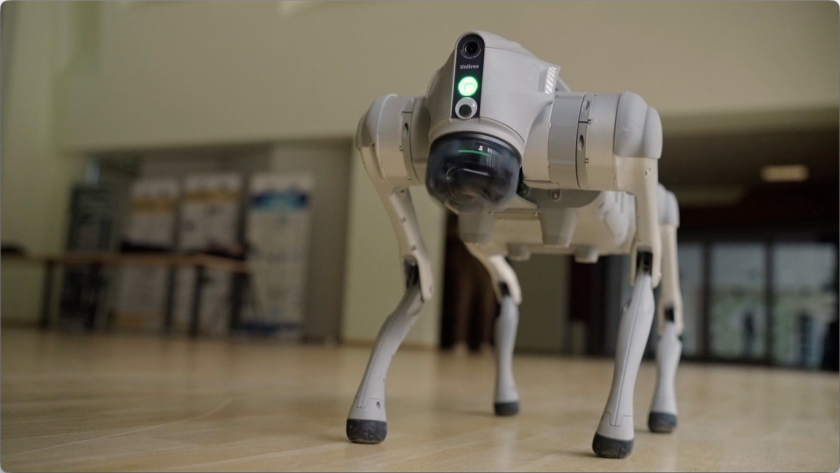
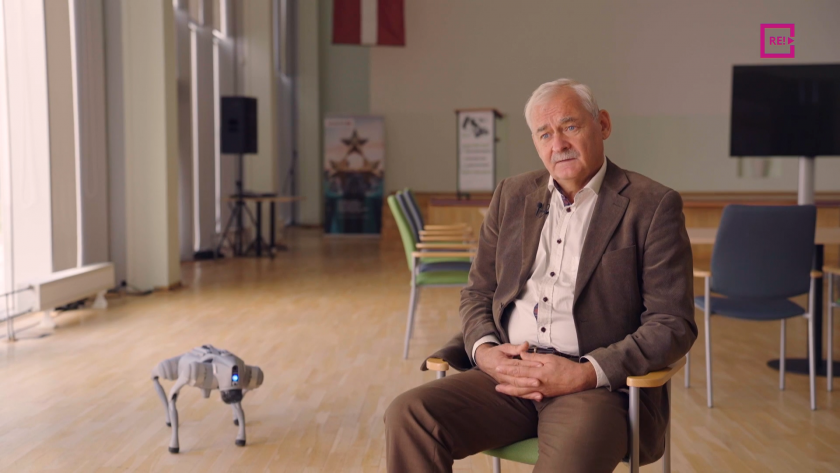
The Institute of Electronics and Computer Science (EDI) is home to an unusual resident – a robot dog named Edijs. Edijs is one of those engineering achievements that came about through experimentation and research into natural mechanisms from the perspective of artificial intelligence and robotics.
As EDI Director Modris Greitāns points out, scientists are always interested in testing whether it is possible to artificially create what nature has already created. “Robot dog Edijs is our attempt to create a mechanical being that can move and react like a living organism,” says Modris Greitāns.
Edijs weighs about 15 kilograms, and his mechanical construction can carry loads of up to seven kilograms. The robot dog’s movements are controlled by artificial intelligence, which coordinates balance, movement synchronization, and reactions to changes in the surrounding environment. Thanks to this artificial intelligence solution, Edijs can walk, jump, stand on his hind legs, and even wave his paw – just like a real dog.
In addition, Eddie is equipped with a camera that allows him to “see” his surroundings and transmit the image to the driver’s smartphone. By changing the wavelength of the camera, it would theoretically be possible to see through certain obstacles, making this technology potentially useful in various security and research fields.
As Modris Greitāns points out, the potential of robots is limited only by the laws of physics. In the future, such four-legged robots could become faster, more durable, and more accurate than live dogs, which currently perform border guard, rescue, and search tasks. Scientists believe that artificial “noses” could eventually surpass the sense of smell of real dogs, opening up new possibilities in human safety and assistance technologies.
Edijs symbolizes the future of innovation, knowledge, and technology – how an experiment in a laboratory can mark the beginning of a new era of human-machine collaboration.
Watch the full story here (starting at 8:33, in Latvian).