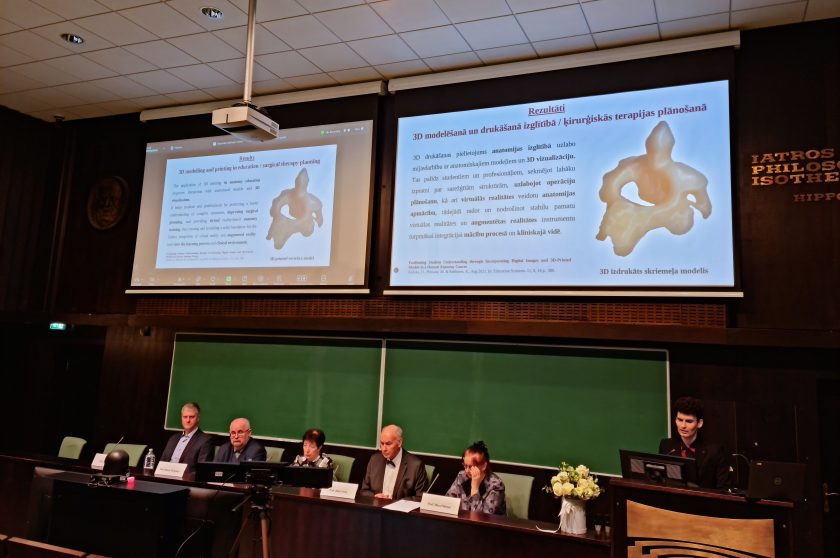
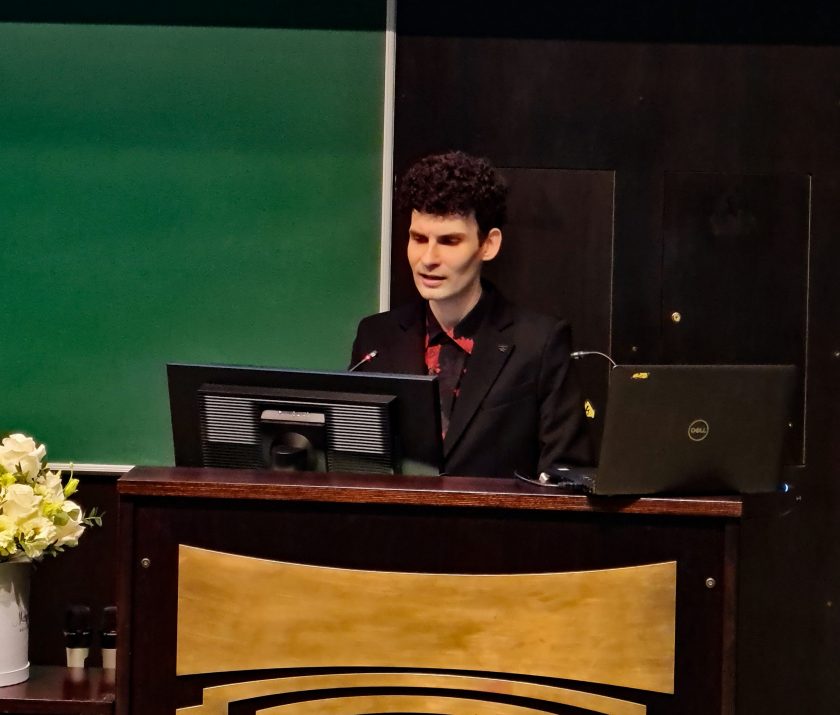
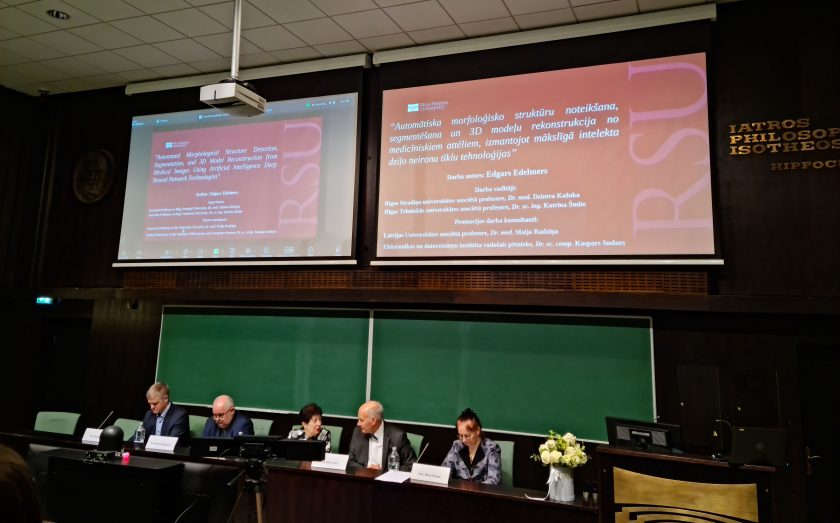
On 29 December 2025, at Rīga Stradiņš University, Edgars Edelmers was awarded the Doctor of Science (PhD) degree in Medical and Health Sciences, defending his doctoral dissertation entitled “Automated Morphological Structure Detection, Segmentation, and 3D Model Reconstruction from Medical Images Using Artificial Intelligence Deep Neural Network Technologies”.
The doctoral dissertation was developed under the scientific supervision of Dr. med., Associate Professor Dzintra Kažoka (Rīga Stradiņš University) and Dr. sc. ing., Associate Professor Katrīna Šmite (Riga Technical University).
Edgars explains:
“I am drawn to everything new and unknown. That is why I chose science, and this curiosity led me to my doctoral research on artificial intelligence in medical imaging, which brings together anatomy, computer science, and engineering. I am convinced that science is not divided into rigid disciplines – the most interesting discoveries emerge where different fields overlap.”
Within the framework of the doctoral research, various applications of artificial intelligence were investigated, including the use of deep neural networks for the detection of spinal metastases, automated cell counting in histological specimens, and the reconstruction of three-dimensional anatomical models for educational and training purposes.
Alongside his research activities, Edgars Edelmers is actively involved in education, teaching at Rīga Stradiņš University and Riga Technical University. In collaboration with colleagues, he has contributed to the development of new study courses on the application of artificial intelligence in diagnostic imaging and 3D modelling. His regular participation in exchange programmes and international conferences reflects the conviction that science is a global process and that continuous professional development is an essential component of it.
Edgars describes himself as an ambitious, challenge-driven researcher, emphasizing that perseverance, determination, and a willingness to learn are decisive factors in achieving knowledge and success. The rapid development of artificial intelligence is opening new opportunities in medicine and society as a whole, and his goal is to be at the forefront of these transformations by contributing to the development of technologies that will shape the future of healthcare and human progress.