
Value proposition
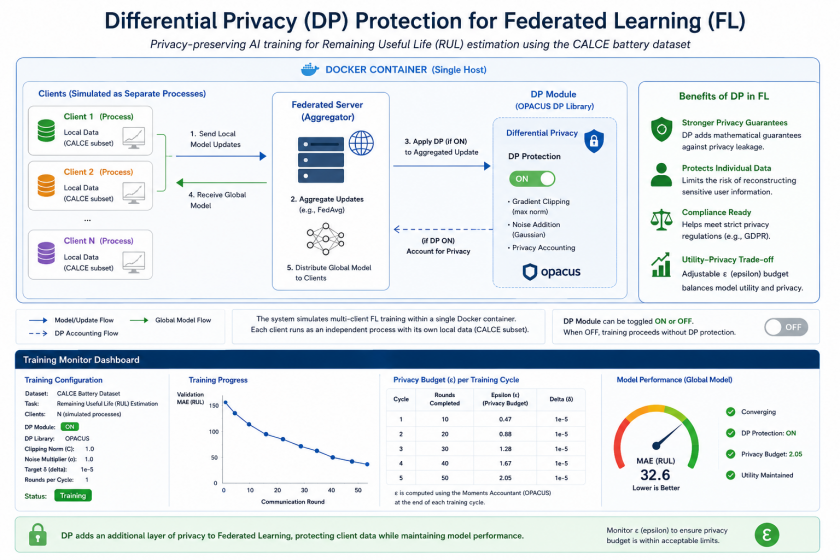
The developed technology offers an additional Differential Privacy (DP) protection for the Federated Learning (FL) system, highlighting the benefits of enhanced privacy. Its demonstrator illustrates the AI module’s training process using the CALCE dataset to estimate a battery’s Remaining Useful Life (RUL). The DP module is implemented with the OPACUS DP library and can be toggled on or off. Multi‑client FL training is simulated with separate processes within a single Docker container. Protection levels can be monitored via epsilon values (the ε‑privacy budget), which the system calculates at the end of each training cycle
Business and innovation perspective
Very often, organizations do not have access to enough data to train deep neural network models (Deep Learning, DL) on their own. They could solve this problem by collaborating and sharing data with other organizations; however, for data protection reasons, this is often not possible (for example, in the healthcare sector, organizations cannot allow unrestricted access to such sensitive data). The developed EDI solution allows multiple organizations to collaborate and train artificial intelligence models without direct data exchange.
Technology Readiness Level (TRL): 4
Intellectual Property Status: Trade Secret (Know-how)
Projects: PowerizeD
Technical specification
The developed system implements a time-series Federated Learning (FL) framework enhanced with Differential Privacy (DP) protection for secure Remaining Useful Life (RUL) prediction using the CALCE battery dataset. In this architecture, multiple simulated clients train local AI models on their own time-series battery data without sharing raw datasets, while a central server coordinates the global training process through the Federated Averaging (FedAvg) algorithm. During each global round, the server distributes the latest global model parameters to participating clients, which perform several local mini-batch training steps using stochastic gradient descent and then return only model updates or gradients to the server for aggregation. To strengthen privacy preservation, the system integrates the OPACUS DP library, which can be dynamically enabled or disabled, adding noise and gradient clipping to the exchanged model updates to protect sensitive information. The multi-client FL environment is simulated as separate processes within a single Docker container, enabling efficient experimentation and scalable deployment. Privacy protection effectiveness is monitored through the epsilon (ε) privacy budget, which is calculated after every training cycle, allowing evaluation of the trade-off between model utility, communication efficiency, and privacy guarantees in time-series forecasting applications.
Collaboration
Collaborative Development: Customization of the technology to meet the client’s specific requirements or further joint development.