
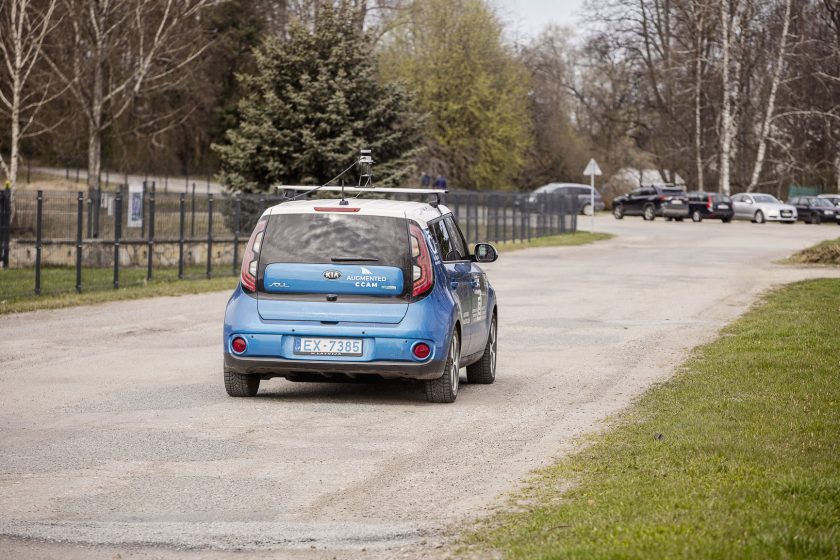
On June 25, EDI Senior Researcher Roberts Kadiķis participated in the final review event of the “Augmented CCAM” project in Brussels, where, alongside the FEHRL-coordinated consortium, he presented the achievements of the project’s second (and final) phase. During this period, the project focused on testing the developed solutions in real-world environments with real users, as well as conducting extended simulation tests. The test results were utilized in micro and macro simulations to determine the impact of the developed solutions not only on direct users but also on broader road regions.
The final presentations demonstrated an ambitious range of solutions piloted in various European countries, including Latvia. Throughout the three-and-a-half-year project, EDI worked on developing and validating three use-case solutions. The first solution enables an autonomous vehicle to assist an emergency vehicle in overtaking it more easily by driving closer to the edge of its lane. The second solution allows the infrastructure to warn an autonomous vehicle about a vulnerable road user (pedestrian, cyclist) approaching the road, whom the vehicle itself cannot detect due to obstacles. In the third solution, the infrastructure assists the autonomous vehicle in navigating around temporary roadworks.
More about the project, its tests, and the demo event can be found here:
- https://www.edi.lv/en/projects/augmenting-and-evaluating-the-physical-and-digital-infrastructure-for-ccam-deployment-augmented-ccam/
- https://www.edi.lv/en/edi-autonomous-vehicle-tested-in-live-traffic-in-adazi/
- https://www.edi.lv/en/edi-showcases-intelligent-transport-solutions-at-autonomous-vehicle-demonstration-in-adazi/