The project’s objective is to:
• Implement structural changes at the Institute of Electronics and Computer Science and the Institute of Physics and Energetics to establish an internationally recognized multidisciplinary scientific institute in Latvia. This institute will participate in international consortia and projects while conducting research in computer science, electronics, information and communication technologies (ICT), energy, and related fields.
The main tasks include:
• Carrying out structural changes for the two scientific institutes
• Ensuring the implementation of academic career grants
• Ensuring the implementation of internal research and development grants
Academic Career Grant Projects Implemented within the E-EDI Project
In September of last year, researchers from the Institute of Electronics and Computer Science and the Institute of Physical Energetics were invited to submit project proposals to the academic career grant competition organised by the Institute of Physical Energetics.
Academic career grants are individual grants aimed at supporting the academic career development of the project applicant.
Within the framework of the total funding available for the competition, two project proposals were approved, with an implementation period lasting until 15 December 2025:
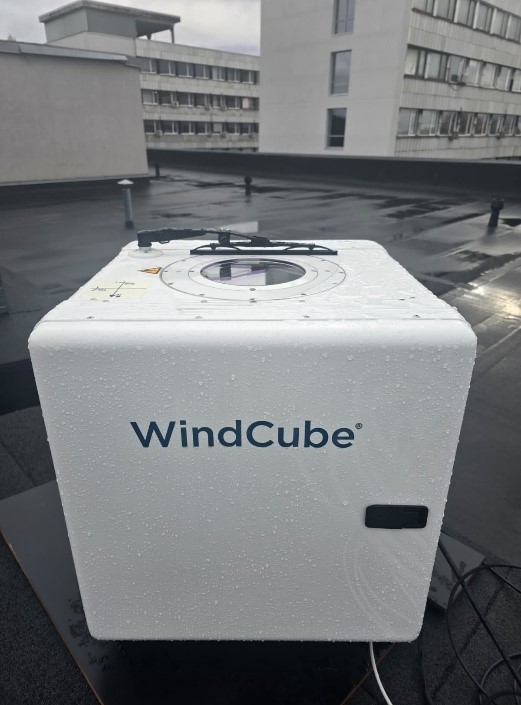
- Advancement of remote sensing-related research and development at the Institute of Electronics and Computer Science
More information on the project objectives and results is available here:
https://www.edi.lv/projects/granta-projekts-ar-talizpeti-saistitu-petijumu-un-attistibas-veicinasana-elektronikas-un-datorzinatnu-instituta/ - Experimental investigation of propagation of acoustic guided waves in structural components of wind turbine blades
More information on the project objectives and results is available here:
https://www.edi.lv/projects/granta-projekts-akustisko-vaditu-vilnu-izplatisanas-eksperimentals-petijums-veja-turbinu-lapstinu-konstrukcijas-elementos-experimental-investigation-of-propagation-of-acoustic-guided-waves/
In accordance with the regulations of the scientific (professors’) grant competition, both projects were submitted for scientific evaluation as to the established project assessment procedure and the requirements of Cabinet of Ministers Regulation No. 721. The implementation of both projects has been completed.
The grant competition was conducted in accordance with Cabinet of Ministers Regulation No. 721 of 5 December 2023.
Internal research and development grants are financed by the Recovery Fund and the state budget and are administered within the framework of the Institute of Electronics and Computer Science project “Expansion of the capacity of the Institute of Electronics and Computer Science with an energy research direction (E-EDI)”, as stipulated by the Cabinet of Ministers regulations.
Delivery of a Real-Time Simulator and Phasor Measurement Unit System within the E-EDI Project
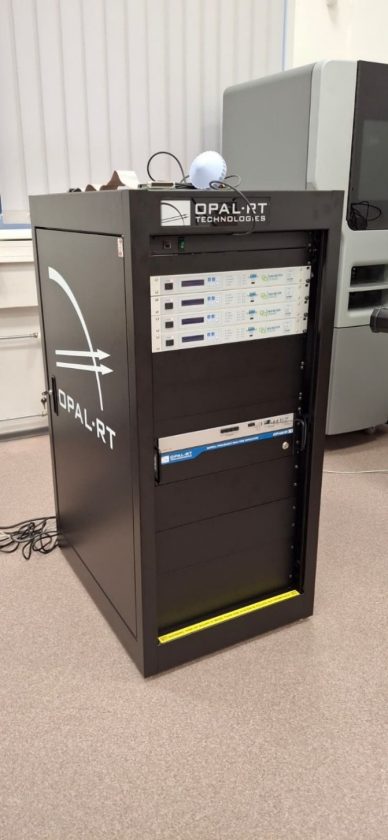
Within the framework of the European Union Recovery Fund project No. 5.2.1.1.i.0/2/24/I/CFLA/006 “Expanding the Capacity of the Institute of Electronics and Computer Science with a Focus on Energy Research (E-EDI)”, a system consisting of an OP4610XG real-time simulator and four STERPMU-R1 phasor measurement units (PMUs) has been acquired.
The OP4610XG combines AMD Ryzen™ processing cores with an AMD Kintex™-7 410T FPGA. Supporting a wide range of communication protocols, the OP4610XG is designed for hardware-in-the-loop (HIL) and rapid control prototyping (RCP) applications, enabling high-speed simulation of complex power system operation and dynamic processes.
The STERPMU-R1 is a synchrophasor measurement device equipped with a rechargeable backup battery, a GPS time source, a 10/100 Mbps Ethernet interface supporting up to two simultaneous C37.118.2-2011 data streams, a GPRS modem, configurable digital inputs and outputs, continuous recording of voltage, frequency and other power system parameters, harmonic analysis, long-term data storage, and an SD card slot allowing local storage of synchrophasor measurements for up to five months.
This combination of equipment enables in-depth research into power system dynamics, stability, and protection algorithms, including testing of power system functionality in realistic simulation scenarios.
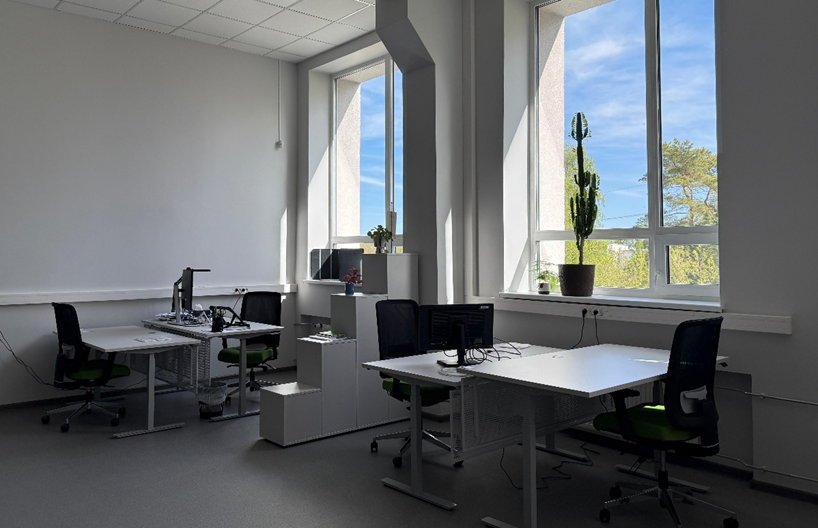
The institute has successfully completed infrastructure development works, resulting in the establishment of the institute’s sixth laboratory – the Energy Research Centre Laboratory.
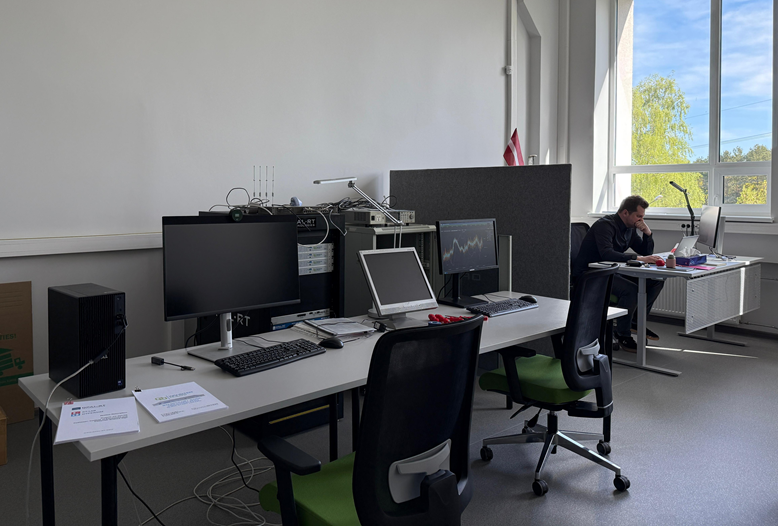
Within the framework of the project, the laboratory premises were renovated and adapted to meet modern research requirements, creating a functional, safe, and comfortable working environment for scientific activities. Renovation works were carried out to ensure compliance with contemporary workplace and research infrastructure standards, and new workstations were established and fully equipped for researchers, research assistants, and industry specialists.
To provide high-quality working conditions and support efficient research processes, the laboratory was equipped with ergonomic office furniture, desks, chairs, computer monitors, IT equipment, and other essential tools for daily work. The premises were also fitted with blinds, lighting solutions, document storage systems, and additional inventory that contributes to a productive and well-organized working environment. These investments have enabled the creation of a modern research infrastructure that meets the requirements of both scientific activities and collaborative project implementation.
The establishment of the new laboratory represents an important step in the institute’s development by expanding its expertise in the field of energy research and creating opportunities for more active participation in national and international research and innovation projects. The modern infrastructure, well-equipped workspace, and improved working conditions strengthen the institute’s ability to attract highly qualified researchers and young scientists, while also promoting interdisciplinary collaboration among experts from different fields.
“Funded by the European Union — NextGenerationEU. The views and opinions expressed are solely those of the author(s) and do not necessarily reflect the views and opinions of the European Union or the European Commission. Neither the European Union nor the European Commission can be held responsible for them.”