

Cytology is a necessary diagnostic test performed daily by veterinary clinicians. Microscopic examination of individual cells or cell clusters on stained or native slides can reveal various diseases like tumors and parasites. Particular knowledge, experience, and significant time are needed to interpret the sample on-site. Alternatively, certified pathologists can review the slides directly or via whole slide imaging (WSI)-based digital pathology systems, leading to diagnostic delays and extra costs.
We propose high-resolution wide-field optical imaging for cytology in veterinary clinics. The project aims to validate holographic microscopy (HM) for automated cytological examination of common conditions in dogs, cats, and cows: inflammation, tumors, and parasites. HM systems are portable and offer computationally cost-effective image reconstruction, including artificial intelligence (AI), which enables direct training from raw holographic images. Because HM is lensless microscopy, its field of view (FoV) is unrelated to the image resolution and matches the camera’s sensor size (tens of mm2) at ×1 magnification. The proposed pixel super-resolution strategy (PSRS) will investigate the variety of HM adjustable factors, including the illumination angle, wavelength, and modification in the sample-to-sensor distance, to obtain submicron pixel resolution at wide FoV. Digital focusing also guarantee a broader depth of field, crucial for focused images throughout cytological slides
regardless of the thickness of the sample. Finally, the state-of-the-art AI algorithms researched and developed by EDI will extract essential cytological features from the acquired images and reach a primary diagnosis.
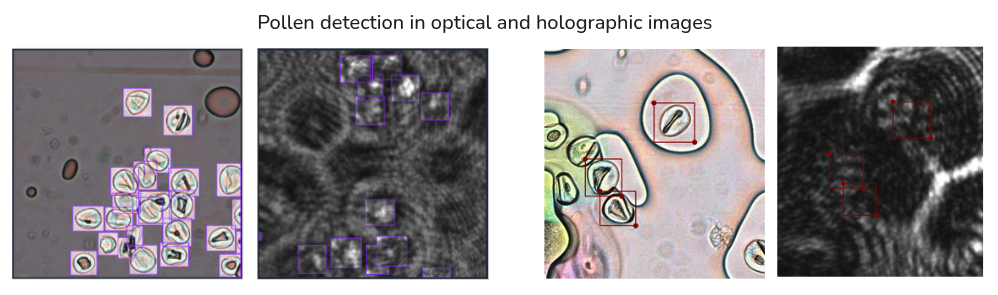
In the project, EDI researches and develops artificial intelligence algorithms that will identify significant cytological features in the obtained images and allow for determining the primary diagnosis. The primary image analysis task being examined is pollen detection and classification in optical as well as holographic images. Since holographic images are challenging even for modern artificial intelligence tools, EDI is exploring possibilities to expand the data used for training artificial intelligence models with synthetic data generation approaches.
Participating scientists