Contact
Modris Greitāns
Dr. sc. comp.
Director of EDI, Senior Researcher
Dr. sc. comp., Member of the Latvian Academy of Sciences Modris Greitāns has been working at the Institute of Electronics and Computer Science (EDI) since 1990. He has been the director of the institute since 2007 (from 2015 to 2019 – scientific director). He obtained his Doctor degree in 2000, defending his PhD thesis "Reconstruction of non-uniformly sampled signals". In 2012, he was elected as corresponding member of the Latvian Academy of Sciences, and in 2018, as a full member. His scientific research topics include signal and image processing, artificial intelligence, Internet of Things applications in smart transport, future and personalized medicine (smart wearable sensor systems), Industry 4.0 solutions, as well as security, etc.
From 2014 to 2017, he led the National Research Program in the field of ICT, "Cyber-physical systems, ontologies and biophotonics for a safe & Intelligent city and society" (SOPHIS), in which a significant section is devoted to the development of smart embedded cooperative system technologies. Since 1992, he has gained experience in the management and implementation of more than 20 international and 20 Latvian research projects. Currently, he is the head of the Latvian partner's part in the Horizon Europe projects SUSTRONICS (dedicated to the development of sustainable electronic components) and EdgeAI (dedicated to peripheral artificial intelligence in mobility applications).
The total number of published scientific works exceeds 150, including 111 publications in the SCOPUS database (H-index 15). He is the co-author of three registered European patents and seven Latvian patents. He has supervised seven successfully defended PhD's and more than thirty master's theses.
In 2018, he received the Eižens Āriņš Award (“Eižena Ārina balva”), the highest award in the IT industry in Latvia. He was co-author of the DASP-lab system, which received the European IT Prize in 1997. He is the lead co-author of several works that have received letters of appreciation from the President of the Latvian Academy of Sciences – "First self-driving car trips in Latvia" (2017) and "An original approach to transforming artificial neural network architecture into programmable logical array structures" (2018). Co-author of works that received the Latvian Science Achievement Award in 2022 – "A unique industrial robotics solution has been created – a smart robot with advanced vision, sensing, and human gesture understanding capabilities" and in 2024 – "Robot cognitive perception and high-level instruction interpretation with natural language concepts.
He is the editor-in-chief of the journal "Automatic Control and Computer Science", foreign affairs secretary and board member of the Latvian Academy of Sciences, board member of the Association of State Scientific Institutes, member of the EDI Scientific Council, and member of the promotion councils of RTU and LU.
Projects
1 result
Publications
- 2025
Implementation of LoRa TDMA-Based Mobile Cell Broadcast Protocol for Vehicular Networks(opens in a new window)
Modris Greitāns, Gatis Gaigals, Aleksandrs Ļevinskis
Information (Switzerland), Vol. 16 (6), MDPI
- 2025
Correction to: Towards Open-Set NLP-Based Multi-Level Planning for Robotic Tasks(opens in a new window)
Peteris Racinskis, Oskars Vismanis, Toms Eduards Zinars, Janis Arents, Modris Greitans
Applied Sciences (Switzerland), Vol. 15 (5), MDPI
Abstract
In the original publication [1], there was a mistake in Table 1 as published. The column data in the table are reversed. The corrected Table 1 appears below. The numbers in the Abstract referring to Table 1 were mismatched. A correction has been made to the Abstract. From “while the semantic maps exhibit maximum recall rates of 94.69% and 92.29% for the 2.5d and 3d versions, respectively.” To “while the semantic maps exhibit maximum recall rates of 92.29% and 94.69% for the 2.5d and 3d versions, respectively.” The statements in the Discussion section citing Table 1 were mismatched. A correction has been made to the Discussion Section, Paragraph 5: From “For the static depth map, using ternary embedding values appears to paradoxically result in slightly improved recall—though this peculiarity is likely to disappear with larger and more varied data sets. With the vectree map, the same output set was produced by 32-bit and 8-bit embeddings, with two otherwise recalled observations being missed (one each of “white bottle” and “energy drink bottle”) and one otherwise missed observation being recalled (“pink foam”).” To “For the vectree map, using ternary-embedding values appears to paradoxically result in slightly improved recall—though this peculiarity is likely to disappear with larger and more varied datasets. With the static depth map, the same output set was produced by 32-bit and 8-bit embeddings, with two otherwise recalled observations being missed (one each of “white bottle” and “energy drink bottle”) and one otherwise missed observation being recalled (“pink foam”) with ternary embeddings.” The authors state that the scientific conclusions are unaffected. This correction was approved by the Academic Editor. The original publication has also been updated. © 2025 Elsevier B.V., All rights reserved.
- 2025
Model Selection and Prompting Strategies in Resource Constrained Environments for LLM-based Robotic System(opens in a new window)
Toms Eduards Zinars, Oskars Vismanis, Peteris Racinskis, Janis Arents, Modris Greitans
Charting the Intelligence Frontiers Edge AI Systems Nexu, p. 147-165, River Publishers Series in Communications and Networking
Abstract
Large Language Models (LLMs) are increasingly becoming adopted for various applications in information processing and content generation. Coupled with the diverse availability of model weights, quantization, and fine-tuning, it is desirable to find the best-performing LLM within a certain memory budget. Prompting strategy plays a similarly major role in the quality of generation, with various methods existing that attempt to induce desired behaviour, requiring a major time investment to develop. As new models with better performance to memory ratio become available, it may be tempting to implement them into an existing system for potential performance improvements. In this work we explore the process of changing weights and note that weights from larger models or of different quantization precision are unable to replace the original model without modifications to the prompt contents, which in turn implies complications in developing modular, weight agnostic Systems.
Indexed in Scopus / WoS
- 2025
The EDI Multi-Modal Simultaneous Localization and Mapping Dataset (EDI-SLAM)(opens in a new window)
Peteris Racinskis , Gustavs Krasnikovs, Janis Arents and Modris Greitans
Data, Vol. 10 (1), p. 5, MDPI
Abstract
This paper accompanies the initial public release of the EDI multi-modal SLAM dataset, a collection of long tracks recorded with a portable sensor package. These include two global shutter RGB camera feeds, LiDAR scans, as well as inertial and GNSS data from an RTK-enabled IMU-GNSS positioning module—both as satellite fixes and internally fused interpolated pose estimates. The tracks are formatted as ROS1 and ROS2 bags, with separately available calibration and ground truth data. In addition to the filtered positioning module outputs, a second form of sparse ground truth pose annotation is provided using independently surveyed visual fiducial markers as a reference. This enables the meaningful evaluation of systems that directly utilize data from the positioning module into their localization estimates, and serves as an alternative when the GNSS reference is disrupted by intermittent signals or multipath scattering. In this paper, we describe the methods used to collect the dataset, its contents, and its intended use.
Indexed in Scopus / WoS · Scopus percentile: 69 · SNIP: 0.857
- 2025
Multi-Step Object Re-Identification on Edge Devices: A Pipeline for Vehicle Re-Identification
Tomass Zutis, Peteris Racinskis, Anzelika Bureka, Janis Judvaitis, Janis Arents, and Modris Greitans
Charting the Intelligence Frontiers – Edge AI Systems Nexus, p. 233-253, River Publishers
Abstract
In modern computer vision tasks, the ability to identify and track objects across different scenes and environments has become important for numerous applications, especially in transportation. Inspired by this need, we propose a method that leverages a multi-step process focused on extracting and using object features for object re-identification. The proposed pipeline includes the following steps: detecting an object, converting its features into a vector embedding, storing this embedding in a vector database, and then querying the database to find the same or similar objects based on their feature embeddings. This approach enables us to identify the same object across different images or cameras, even in varying locations. This is essential in scenarios like Vehicle Re-Identification. For such scenario, implementing this process on edge devices is crucial. Therefore, ways to tailor the pipeline and its outputs for edge devices are outlined. The paper details the pipeline’s structure along with the experimental setup demonstrating its application, particularly in vehicle re-identification. The pipeline achieves 70-80% re-identification precision when dealing with vehicle images from our network cameras and above 70% Rank-1 accuracy when dealing with a CityFlow video track scenario.
Patents
2018 LR patents Nr. 15308
Mobila ierīce bezvadu sensoru tīklu un to mezglu efektīvai izstrādei mērķa vide
Inventors:Leo SEĻĀVO, Krišjānis NESENBERGS, Jānis JUDVAITIS, Didzis LAPSA, Rihards BALAŠS, Arnis SALMIŅŠ, Modris GREITĀNS
Description and link
View the patent on Espacenet(opens in a new window)LR patents Nr. 15308 “Mobila ierīce bezvadu sensoru tīklu un to mezglu efektīvai izstrādei mērķa vide”, Izgudrotāji Leo SEĻĀVO, Krišjānis NESENBERGS, Jānis JUDVAITIS, Didzis LAPSA, Rihards BALAŠS, Arnis SALMIŅŠ, Modris GREITĀNS, publicēts 20.03.2018.
2016 European Patent No. EP 2695104 B1
Biometric authentication apparatus and biometric authentication method
Inventors:M.Greitans, M.Pudzs, R.Fuksis, R.Ruskuls
Description and link
View the patent on Espacenet(opens in a new window)EP2695104 (type: A1, date: 12.02.2014; type: B1, date: 27.07.2016) “Biometric authentication apparatus and biometric authentication method”. Inventors: M.Greitans, M.Pudzs, R.Fuksis, R.Ruskuls. Applicant:
Institute of Electronics and Computer Sciences of Latvia.2015 European Patent No. EP2700054 B1
System and method for video-based vehicle detection
Inventors:K.Freivalds, R.Kadikis, M.Greitans
Description and link
View the patent on Espacenet(opens in a new window)EP2700054 (type: A1, date: 26.02.2014; type: B1, date: 22.04.2015) “System and method for video-based vehicle detection”. Inventors: K.Freivalds, R.Kadikis, M.Greitans. Applicant:
Institute of Electronics and Computer Sciences of Latvia.2015 European Patent No. EP2695297 B1
Ultra-wideband sharpener for excitation a symmeric antenna
Inventors:M.Greitans, K.Krumins, V.Aristovs
Description and link
View the patent on Espacenet(opens in a new window)EP2695297 (type: A1, date: 12.02.2014; type: B1, date: 08.07.2015) “Ultra-wideband sharpener for excitation a symmeric antenna”. Inventors: M.Greitans, K.Krumins, V.Aristovs.
Applicant: Institute of Electronics and Computer Sciences of Latvia.2013 LR patents Nr. 14767
Former of excitation pulses for symmetrical Ultra-wideband (UWB) antenna
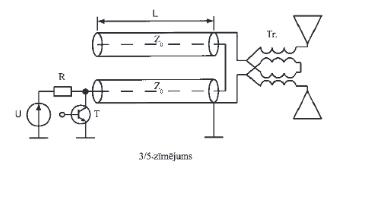
Inventors:M.Greitāns, V.Aristovs, G.Šūpols. Owner: Institute of Electronics and Computer Science. Published: 20.11.2013. The purpose of the invention is, by modifying circuit of prototype, to obtain a sub-nanosecond impulse former for excitation of a symmetrical ultra-wideband (UWB) antenna. The pulse former consists of two coaxial cable segments with length L and characteristic impedance Z 0 , direct current voltage supply U, charging current limiting resistor R, switch element – avalanche transistor T, symmetrical antenna and asymmetrical pulse former balancing transformer Tr. http://www.lrpv.gov.lv/sites/default/files/20131120.pdf
Description and link
View the patent on Espacenet(opens in a new window)Latvian Patent No. 14767 “Former of excitation pulses for symmetrical Ultra-wideband (UWB) antenna”. Inventors: M.Greitāns, V.Aristovs, G.Šūpols. Owner: Institute of Electronics and Computer Science. Published: 20.11.2013.
The purpose of the invention is, by modifying circuit of prototype, to obtain a sub-nanosecond impulse former for excitation of a symmetrical ultra-wideband (UWB) antenna. The pulse former consists of two coaxial cable segments with length L and characteristic impedance Z 0 , direct current voltage supply U, charging current limiting resistor R, switch element – avalanche transistor T, symmetrical antenna and asymmetrical pulse former balancing transformer Tr.