
Kontakti
Modris Greitāns
Dr. sc. comp.
EDI direktors, vadošais pētnieks
Dr. sc. comp., LZA akadēmiķis Modris Greitāns Elektronikas un datorzinātņu institūtā (EDI) strādā kopš 1990. gada. Kopš 2007. gada ir institūta direktors (no 2015 līdz 2019 – zinātniskais direktors). Zinātņu doktora grādu ieguvis 2000. gadā, aizstāvot promocijas darbu “Neregulāri diskretizētu signālu rekonstrukcija”. 2012. gadā ievēlēts par Latvijas Zinātņu akadēmijas korespondētājlocekli, bet 2018. gadā – par LZA īsteno locekli. Zinātnisko pētījumu tematika ietver signālu un attēlu apstrādi, mākslīgo intelektu, lietu interneta pielietojumiem viedā transportā, nākotnes un personalizētā medicīnā (viedas valkājamas sensoru sistēmas), Industrija 4.0 risinājumos, kā arī drošībai u.c.
Laikā no 2014. līdz 2017. gadam vadījis Valsts pētījumu programmu IKT jomā “Kiberfizikālās sistēmas, ontoloģijas un biofotonika drošai un viedai pilsētai un sabiedrībai” (SOPHIS), kurā būtiska sadaļa veltīta viedu iegultu kooperatīvu sistēmu tehnoloģiju attīstībai. Kopš 1992. gada uzkrāta pieredze vairāk nekā 20 starptautisko un 20 Latvijas pētniecības projektu vadībā un īstenošanā. Pašlaik ir Latvijas partnera daļas vadītājs „Apvārsnis Eiropa” projektos SUSTRONICS (veltīts ilgtspējīgas elektronikas komponenšu attīstībai) un EdgeAI (veltīts perifiālam mākslīgam intelektam mobilitātes pielietojumos).
Kopējais publicēto zinātnisko darbu skaits pārsniedz 150, tostarp 111 publikācijas SCOPUS datubāzē (H-indekss - 15). Ir 3 reģistrētu Eiropas patentu un 7 Latvijas patentu līdzautors. Vadījis septiņus sekmīgi aizstāvētus promocijas darbus un vairāk nekā trīsdesmit maģistra darbus.
2018. gadā saņēmis Eižena Āriņa balvu – augstāko apbalvojumu IT nozarē Latvijā. Bijis līdzautors 1997. gadā Eiropas IT balvu (European IT Prize) saņēmušajai sistēmai “DASP-lab system”. Vadošais līdzautors vairākiem darbiem, kas saņēmuši LZA prezidenta pateicības rakstus - „Pirmie pašbraucoša auto braucieni Latvijā” (2017) un „Oriģināla pieeja mākslīgo neironu tīklu arhitektūras transformēšanai programmējamo loģisko masīvu struktūrās” (2018). Līdzautors Latvijas Zinātnes gada sasnieguma balvu saņēmušajiem darbiem 2022. gadā - “Radīts unikāls industriālās robotikas risinājums – viedais robots ar attīstītām redzes, jušanas un cilvēka žestu saprašanas spējām” un 2024. gadā - “Robota kognitīvā uztvere un augsta līmeņa instrukciju interpretācija ar dabiskās valodas jēdzieniem”.
Ir žurnāla “Automatic Control and Computer Science” galvenais redaktors, Latvijas Zinātņu akadēmijas ārlietu sekretārs un valdes loceklis, Valsts zinātnisko institūtu asociācijas valdes loceklis, EDI Zinātniskās padomes loceklis, kā arī RTU un LU promocijas padomju loceklis.
Projekti
1 rezultāts
Publikācijas
- 2025
Implementation of LoRa TDMA-Based Mobile Cell Broadcast Protocol for Vehicular Networks(atveras jaunā logā)
Modris Greitāns, Gatis Gaigals, Aleksandrs Ļevinskis
Information (Switzerland), Sēj. 16 (6), MDPI
Kopsavilkums
<p>With increasing vehicle density and growing demands on transport infrastructure, there is a need for resilient, low-cost communication systems capable of supporting safety-critical applications, especially in situations where primary channels like Wi-Fi or LTE are unavailable. This paper proposes a novel, real-time vehicular network protocol that functions as an emergency fallback communication layer using long-range LoRa modulation and off-the-shelf hardware. The core contribution is a development of Mobile Cell Broadcast Protocol that is implemented using Long-Range modulation and time-division multiple access (TDMA)-based cell broadcast protocol (LoRA TDMA) capable of supporting up to six dynamic clients to connect and exchange lightweight cooperative awareness messages. The system achieves a sub-100 ms node notification latency, meeting key low-latency requirements for safety use cases. Unlike conventional ITS stacks, the focus here is not on full-featured data exchange but on maintaining essential communication under constrained conditions. Protocol has been tested in laboratory to check its ability to ensure real-time data exchange between dynamic network nodes having 14 bytes of payload per data packet and 100 ms network member notification latency. While focused on vehicular safety, the solution is also applicable to autonomous agents (robots, drones) operating in infrastructure-limited environments. © 2025 Elsevier B.V., All rights reserved.</p>
- 2025
Correction to: Towards Open-Set NLP-Based Multi-Level Planning for Robotic Tasks(atveras jaunā logā)
Peteris Racinskis, Oskars Vismanis, Toms Eduards Zinars, Janis Arents, Modris Greitans
Applied Sciences (Switzerland), Sēj. 15 (5), MDPI
Kopsavilkums
In the original publication [1], there was a mistake in Table 1 as published. The column data in the table are reversed. The corrected Table 1 appears below. The numbers in the Abstract referring to Table 1 were mismatched. A correction has been made to the Abstract. From “while the semantic maps exhibit maximum recall rates of 94.69% and 92.29% for the 2.5d and 3d versions, respectively.” To “while the semantic maps exhibit maximum recall rates of 92.29% and 94.69% for the 2.5d and 3d versions, respectively.” The statements in the Discussion section citing Table 1 were mismatched. A correction has been made to the Discussion Section, Paragraph 5: From “For the static depth map, using ternary embedding values appears to paradoxically result in slightly improved recall—though this peculiarity is likely to disappear with larger and more varied data sets. With the vectree map, the same output set was produced by 32-bit and 8-bit embeddings, with two otherwise recalled observations being missed (one each of “white bottle” and “energy drink bottle”) and one otherwise missed observation being recalled (“pink foam”).” To “For the vectree map, using ternary-embedding values appears to paradoxically result in slightly improved recall—though this peculiarity is likely to disappear with larger and more varied datasets. With the static depth map, the same output set was produced by 32-bit and 8-bit embeddings, with two otherwise recalled observations being missed (one each of “white bottle” and “energy drink bottle”) and one otherwise missed observation being recalled (“pink foam”) with ternary embeddings.” The authors state that the scientific conclusions are unaffected. This correction was approved by the Academic Editor. The original publication has also been updated. © 2025 Elsevier B.V., All rights reserved.
- 2025
Model Selection and Prompting Strategies in Resource Constrained Environments for LLM-based Robotic System(atveras jaunā logā)
Toms Eduards Zinars, Oskars Vismanis, Peteris Racinskis, Janis Arents, Modris Greitans
Charting the Intelligence Frontiers Edge AI Systems Nexu, lpp. 147-165, River Publishers Series in Communications and Networking
Kopsavilkums
Large Language Models (LLMs) are increasingly becoming adopted for various applications in information processing and content generation. Coupled with the diverse availability of model weights, quantization, and fine-tuning, it is desirable to find the best-performing LLM within a certain memory budget. Prompting strategy plays a similarly major role in the quality of generation, with various methods existing that attempt to induce desired behaviour, requiring a major time investment to develop. As new models with better performance to memory ratio become available, it may be tempting to implement them into an existing system for potential performance improvements. In this work we explore the process of changing weights and note that weights from larger models or of different quantization precision are unable to replace the original model without modifications to the prompt contents, which in turn implies complications in developing modular, weight agnostic Systems.
Indeksēts Scopus / WoS
- 2025
The EDI Multi-Modal Simultaneous Localization and Mapping Dataset (EDI-SLAM)(atveras jaunā logā)
Peteris Racinskis , Gustavs Krasnikovs, Janis Arents and Modris Greitans
Data, Sēj. 10 (1), lpp. 5, MDPI
Kopsavilkums
This paper accompanies the initial public release of the EDI multi-modal SLAM dataset, a collection of long tracks recorded with a portable sensor package. These include two global shutter RGB camera feeds, LiDAR scans, as well as inertial and GNSS data from an RTK-enabled IMU-GNSS positioning module—both as satellite fixes and internally fused interpolated pose estimates. The tracks are formatted as ROS1 and ROS2 bags, with separately available calibration and ground truth data. In addition to the filtered positioning module outputs, a second form of sparse ground truth pose annotation is provided using independently surveyed visual fiducial markers as a reference. This enables the meaningful evaluation of systems that directly utilize data from the positioning module into their localization estimates, and serves as an alternative when the GNSS reference is disrupted by intermittent signals or multipath scattering. In this paper, we describe the methods used to collect the dataset, its contents, and its intended use.
Indeksēts Scopus / WoS · Scopus procentile: 69 · SNIP: 0.857
- 2025
Multi-Step Object Re-Identification on Edge Devices: A Pipeline for Vehicle Re-Identification
Tomass Zutis, Peteris Racinskis, Anzelika Bureka, Janis Judvaitis, Janis Arents, and Modris Greitans
Charting the Intelligence Frontiers – Edge AI Systems Nexus, lpp. 233-253, River Publishers
Kopsavilkums
In modern computer vision tasks, the ability to identify and track objects across different scenes and environments has become important for numerous applications, especially in transportation. Inspired by this need, we propose a method that leverages a multi-step process focused on extracting and using object features for object re-identification. The proposed pipeline includes the following steps: detecting an object, converting its features into a vector embedding, storing this embedding in a vector database, and then querying the database to find the same or similar objects based on their feature embeddings. This approach enables us to identify the same object across different images or cameras, even in varying locations. This is essential in scenarios like Vehicle Re-Identification. For such scenario, implementing this process on edge devices is crucial. Therefore, ways to tailor the pipeline and its outputs for edge devices are outlined. The paper details the pipeline’s structure along with the experimental setup demonstrating its application, particularly in vehicle re-identification. The pipeline achieves 70-80% re-identification precision when dealing with vehicle images from our network cameras and above 70% Rank-1 accuracy when dealing with a CityFlow video track scenario.
Patenti
2018 LR patents Nr. 15308
Mobila ierīce bezvadu sensoru tīklu un to mezglu efektīvai izstrādei mērķa vide
Izgudrotāji:Leo SEĻĀVO, Krišjānis NESENBERGS, Jānis JUDVAITIS, Didzis LAPSA, Rihards BALAŠS, Arnis SALMIŅŠ, Modris GREITĀNS
Apraksts un saite
Skatīt patentu Espacenet datubāzē(atveras jaunā logā)LR patents Nr. 15308 “Mobila ierīce bezvadu sensoru tīklu un to mezglu efektīvai izstrādei mērķa vide”, Izgudrotāji Leo SEĻĀVO, Krišjānis NESENBERGS, Jānis JUDVAITIS, Didzis LAPSA, Rihards BALAŠS, Arnis SALMIŅŠ, Modris GREITĀNS, publicēts 20.03.2018.
2016 European Patent No. EP 2695104 B1
Biometric authentication apparatus and biometric authentication method
Izgudrotāji:M.Greitans, M.Pudzs, R.Fuksis, R.Ruskuls
Apraksts un saite
Skatīt patentu Espacenet datubāzē(atveras jaunā logā)EP2695104 (type: A1, date: 12.02.2014; type: B1, date: 27.07.2016) “Biometric authentication apparatus and biometric authentication method”. Inventors: M.Greitans, M.Pudzs, R.Fuksis, R.Ruskuls. Applicant:
Institute of Electronics and Computer Sciences of Latvia.2015 European Patent No. EP2700054 B1
System and method for video-based vehicle detection
Izgudrotāji:K.Freivalds, R.Kadikis, M.Greitans
Apraksts un saite
Skatīt patentu Espacenet datubāzē(atveras jaunā logā)EP2700054 (type: A1, date: 26.02.2014; type: B1, date: 22.04.2015) “System and method for video-based vehicle detection”. Inventors: K.Freivalds, R.Kadikis, M.Greitans. Applicant:
Institute of Electronics and Computer Sciences of Latvia.2015 European Patent No. EP2695297 B1
Ultra-wideband sharpener for excitation a symmeric antenna
Izgudrotāji:M.Greitans, K.Krumins, V.Aristovs
Apraksts un saite
Skatīt patentu Espacenet datubāzē(atveras jaunā logā)EP2695297 (type: A1, date: 12.02.2014; type: B1, date: 08.07.2015) “Ultra-wideband sharpener for excitation a symmeric antenna”. Inventors: M.Greitans, K.Krumins, V.Aristovs.
Applicant: Institute of Electronics and Computer Sciences of Latvia.2013 LR patents Nr. 14767
Simetriskas ultra-platjoslas (UWB) antenas triecienierosmes impulsa formētājs
Izgudrotāji:M.Greitāns, V.Aristovs, G.Šūpols
Apraksts un saite
Skatīt patentu Espacenet datubāzē(atveras jaunā logā)LR patents Nr. 14767 “Simetriskas ultra-platjoslas (UWB) antenas triecienierosmes impulsa formētājs”. Izgudrotāji: M.Greitāns, V.Aristovs, G.Šūpols. Īpašnieks: Elektronikas un datorzinātņu institūts. Publicēts 20.11.2013.
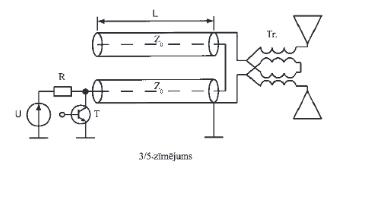
Izgudrojuma mērķis ir, modificē jotprototipa shēmu, to piemērot pikosekunžu platuma impulsu formēšanai simetriskas antenas triecienierosmei, lai iegūtu ultraplatjoslas (UWB) impulsus. Piedāvātais ultraplatjoslas antennas triecienierosmes impulsa formētājs sastāv no diviem koaksiāliem līniju nogriežņiem ar garumu L un viļņu pretestību Z0, līdzsprieguma barošanas avota U un līnijas pakāpeniskas uzlādes nodrošināšanai nepieciešamā, strāvas ierobežojošā Rezistora R, slēdža elementa – lavīntranzistora T, kā arī no simetrisko antenu un nesimetrisko impulsu formētāju Salāgojošā viļņu transformatora Tr.